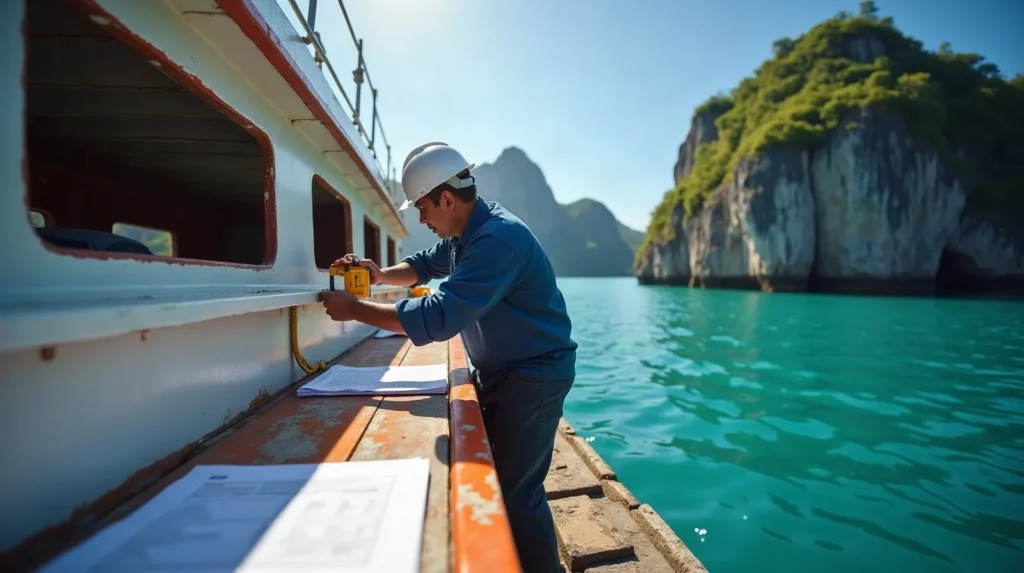
To spec a dive tender for Raja Ampat operations, start from four fixed constraints: the Dampier Strait’s strong tidal currents, wind chop on the Sorong–Waisai crossing, equatorial sun, and the distance to the nearest workshop. A workable specification for this region is a 7–12 m hull with generous freeboard forward, a fine entry that softens short chop, shade over at least two thirds of the deck, secured cylinder racks for every diver plus spares, twin-engine redundancy or a documented single-engine contingency, and fuel capacity sized for the longest planned run with a 30 percent reserve. Everything else — layout, ladder type, electronics — follows from how many divers you carry and how far from base you operate.
Start with the operating profile, not the boat
The most common specification error we see in commissioning briefs is starting with a hull someone admired elsewhere and trying to bend the operation around it. The disciplined sequence runs the other way. Write down your longest routine run in nautical miles, your maximum diver count including guides, the heaviest single item the boat must carry (usually a compressor, spare outboard, or camera cases), and the sea state you will still operate in before cancelling. In Raja Ampat that last answer usually means a confused 1–1.5 m chop where the tidal stream meets wind in the Dampier Strait. Those four numbers drive length, beam, power, and tank capacity more reliably than any brochure.
Sizing: divers, gear, and honest payload math
A realistic payload budget assigns roughly 100 kg per diver once you count the person, a full cylinder, weights, and a gear bag. Twelve divers plus two crew is therefore about 1.4 tonnes before water, fuel, and oxygen kit. That figure is why an 8 m tender that looks spacious at the jetty can sit dangerously low on a full-load crossing. If your diver count regularly reaches ten or more, a 10 m hull with a proper load line calculation is the safer specification; our working comparison in the 8–12 diver tender size guide walks through the arithmetic class by class.
Sea-keeping features that matter in the Dampier Strait
Between Sorong and Waisai the tide can run hard against the prevailing wind, stacking waves short and steep. The features that earn their cost in that water are a moderate-to-deep forward deadrise that flattens aft for shallow anchorages, spray chines that keep guests dry at cruising speed, and a helm position with genuine visibility over the bow when the boat trims up. Self-draining decks are non-negotiable: a boarding sea must leave the boat without a bilge pump being the only line of defence.
Dive-specific deck hardware
Cylinder racks should hold tanks vertically or at a slight lean, padded, with a strap per cylinder rather than a single bar across six. Plan one rack slot per diver plus at least twenty percent spares capacity for stage bottles and rentals. The entry and exit system deserves as much attention as the engines: a wide transom gate or side gate, a ladder that reaches at least a metre below the surface, and grab rails placed where a diver in full kit actually reaches. Camera operations add rinse tanks and padded tables, which we cover separately in the camera-friendly deck guide.
Power, range, and redundancy
Remote West Papua rewards conservative powering. Specify engines so the boat cruises at 70–80 percent throttle with a full load, not at maximum continuous output. Twin outboards cost more in USD terms up front and in servicing, but they turn a mid-channel failure into an inconvenience instead of a rescue. Fuel tankage should cover your longest run both ways plus 30 percent; refuelling options between Sorong, Waisai, and the southern islands are limited and irregular.
Writing the specification down
A one-page specification sheet — operating area, diver count, payload, speed at load, range, deck plan sketch, and the standards the build must meet — is the document a designer and yard can actually quote against. We prepare that sheet with owners as the first step of every commission, then supervise the build at partner yards and run trials before delivery north. The full process, from brief to handover in Sorong, is described in our custom dive tender commissioning service and in the wider Raja Ampat boat commissioning guide.
Electronics and communications for a guest-carrying tender
A Raja Ampat specification should treat communications as safety equipment, not accessories. The working minimum is a fixed VHF with a properly mounted antenna, a GPS chartplotter loaded with the most recent survey data available for the region, a depth sounder the helm can read in sunlight, and a waterproof grab bag holding a handheld VHF and a phone in a dry case. Operators running beyond the strait should add a satellite messenger or phone, because mobile coverage disappears quickly outside the main corridors. Navigation lights must be specified for real night use, not just compliance: transfers run late more often than schedules admit. None of these items is exotic, but each must appear in the specification sheet with a mounting position and a power budget, or the yard will fit whatever is on the shelf, wherever is easiest to drill.
A worked sizing example from a typical brief
Consider a homestay operator running ten divers from Waisai: two sites daily inside a 15-mile radius, occasional strait crossings for pickups, weekly beach landings. Payload math gives ten divers plus two crew at roughly 1.25 tonnes with gear and consumables. That points to a 9–9.5 m hull; the beach landings argue for moderate transom deadrise with a keel shoe; the crossings argue for a fine entry and twin mid-range outboards; the radius sets tankage near 400 litres with reserve. In one paragraph, the operation has produced its boat. This is the discipline the rest of the specification process defends: every line traceable to an operating fact, nothing chosen from a catalogue photograph.
Frequently Asked Questions
How many divers should one tender carry in Raja Ampat?
Most operators settle on eight to twelve divers per tender. Beyond twelve, briefing quality drops, entries slow down, and the payload pushes you into a larger, heavier class of boat. Two smaller tenders often serve a sixteen-guest operation better than one large one.
What cruising speed should I specify for a Raja Ampat dive tender?
A loaded cruise of 18–22 knots covers the common site runs efficiently without punishing guests in chop. Chasing 30-knot top speeds adds fuel burn and structural cost that rarely pays back in this region.
Do I need a cabin on a dive tender for Raja Ampat?
Not usually. A hardtop with good side shade handles sun and squalls for day operations. A cabin adds weight and windage, and makes sense mainly for long crossings or when the boat doubles as crew transport; see our open-versus-cabin comparison for the trade-offs.
Raja Ampat Boat Builder Desk — a specialist maritime brand under Juara Holding Group. Construction contracts issued by PT Komodo Galangan Nusantara. WhatsApp +62 811-3941-4563 · bd@juaraholding.com
Before you lock the spec sheet, read the top mistakes owners make when specifying a new dive tender.