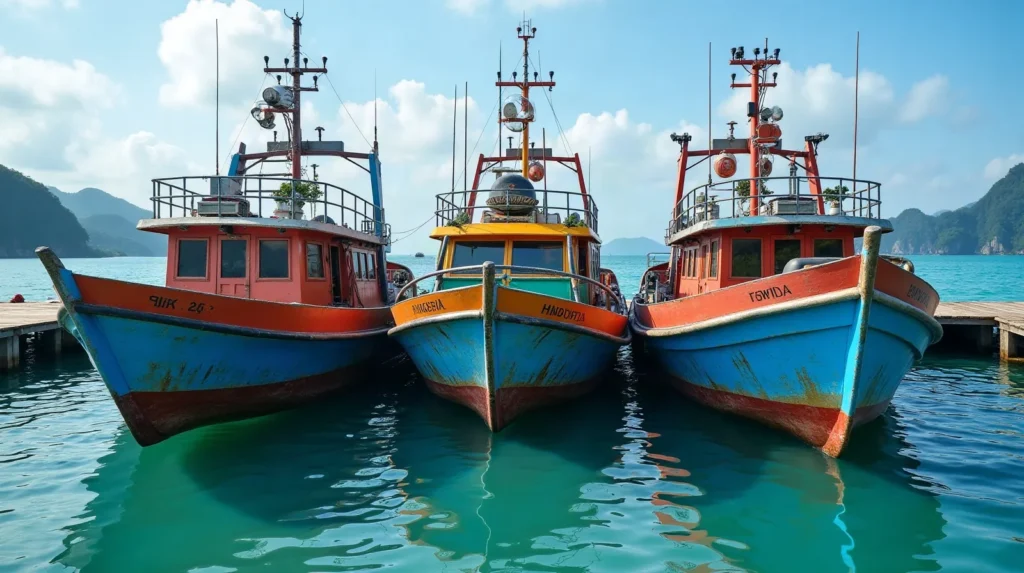
For 8–12 divers, the working answer is a 9–10 m dive tender: long enough to carry roughly 1.2–1.4 tonnes of divers and gear with proper freeboard, short enough to stay manageable at reef moorings and affordable to run. An 8 m hull handles eight divers honestly but is full at ten; a 12 m hull carries twelve in comfort yet costs meaningfully more in USD to build, power, and fuel. This comparison sets out the numbers so you can match the hull to the group size you actually run in Raja Ampat, week in and week out.
The payload arithmetic that sets the floor
Count 100 kg per diver — person, full cylinder, weights, bag — plus two crew, plus a working allowance of 150–250 kg for water, oxygen kit, spares, and fuel margin. Eight divers is therefore about 1.05 tonnes of payload; twelve divers is close to 1.5 tonnes. A hull must carry that load and still keep its designed waterline, freeboard, and self-draining deck height. That is the honest reason size classes exist: not seating, but displacement.
8 m class: the compact workhorse at its limit
An 8 m tender suits a settled group of eight with standard recreational kit. Strengths: lowest build and operating cost of the class, easy to beach-land, light enough for modest davits when it doubles as a liveaboard tender. Weaknesses: at ten divers the kit-up zone crowds, trim becomes sensitive to where people sit, and the ride in Dampier Strait chop degrades because the hull cannot carry the weight forward. If your bookings routinely push past eight, the 8 m boat is the wrong economy — a point our size and specification guide makes across the whole range.
9–10 m class: the sweet spot for 8–12
Around 9.5–10 m, everything relaxes. Twelve rack slots fit with spares capacity, the walkway stays clear at full load, and the extra waterline length adds sea-keeping exactly where Raja Ampat needs it — the wind-against-tide crossing. Twin 115–150 hp outboards give a loaded cruise of 18–22 knots with redundancy for remote water. Fuel burn rises over the 8 m boat, but per diver carried it usually falls. This is the class we specify most often for resort and homestay operations carrying mixed groups, and the layout logic in the deck layout guide applies to it directly.
12 m class: comfort, crossings, and cost
A 12 m tender carries twelve divers with genuine comfort — wide walkways, camera bench, shaded seating for the full group — and handles the longer southern runs toward Batanta and beyond with margin. The costs are real: heavier engines, roughly a third more fuel per mile than the 10 m class, bigger davit and mooring demands, and a build price in USD that steps up with every metre. Choose it when the boat also serves as crew transport or supply craft between sites, a dual role covered in the main commissioning guide.
Choosing against your real booking pattern
Pull your last two seasons of manifests and count how often you carried nine or more divers. If it is under a quarter of departures, an 8 m boat plus occasional double runs may serve; if it is most departures, the 9–10 m class pays for itself in guest experience and schedule reliability. When we take a commission through our custom dive tender service, this manifest review is the first working session, because the honest data usually settles the size question before any drawings are made.
Crew requirements across the size classes
Size changes crewing, and crewing changes operating cost permanently. An 8 m tender runs legally and practically with a skipper and one deckhand. The 9–10 m class is comfortable with the same pair, though camera-heavy groups justify a third hand. At 12 m with twelve divers aboard, two crew are stretched: cylinder handling, line work at moorings, and guest attention all compete, and most operators settle on three. Over a season, that third salary is a larger figure than the fuel difference between the classes — a point that rarely appears in size discussions and always appears in year-end accounts. Match the crew plan to the hull before signing, not after the first exhausting month.
Mooring, storage, and the shore side of the size decision
A tender spends most of its life attached to the shore infrastructure you already have. Check jetty depth at low water against each candidate size, mooring exposure against the windage of a bigger hull, and haul-out options: facilities around Sorong handle the 8–10 m classes routinely, while a 12 m boat needs more planning for its annual bottom work. If the boat will live on a beach mooring at a homestay, the lighter classes win on ground tackle and recovery after squalls. None of this decides the size by itself, but shore constraints have vetoed more specifications than hydrodynamics ever has.
Frequently Asked Questions
Is one 12 m tender better than two 8 m tenders for twelve divers?
Two smaller tenders give schedule flexibility, redundancy, and smaller groups per guide, at higher combined crew and maintenance cost. One 12 m boat is simpler to crew and maintain. Operators running two sites a day usually favour the pair; single-site operations favour the one larger hull.
What engine power suits a 10 m tender for 12 divers?
Twin outboards totalling 230–300 hp typically give a loaded cruise near 20 knots with reserve. Specify for cruise at 70–80 percent throttle under full load rather than for a light-boat top speed.
How much does tender size affect fuel cost per trip?
Stepping from 8 m to 10 m adds roughly 20–30 percent fuel per mile at like-for-like speed; from 10 m to 12 m adds a similar step. Per diver carried, the mid-size class is usually the most efficient once loads pass eight.
Raja Ampat Boat Builder Desk — a specialist maritime brand under Juara Holding Group. Construction contracts issued by PT Komodo Galangan Nusantara. WhatsApp +62 811-3941-4563 · bd@juaraholding.com
Size interacts with shelter: an 8–12 diver deck behaves differently once you add a cabin — compare open vs cabin dive tenders for tropical operations.