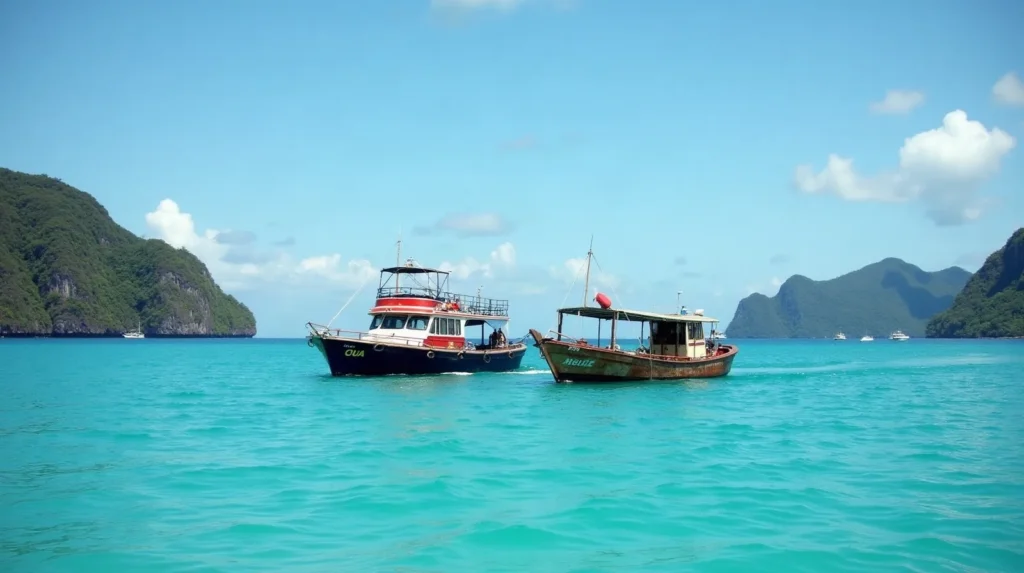
For tropical dive operations, an open tender with a well-designed hardtop beats a cabin tender in most day-boat roles: it is lighter, cooler in still air, faster to load, and less costly to build and power. A cabin earns its place in three cases — long exposed crossings where guests need dry shelter, dual-role boats that carry crew or supplies in all weather, and operations that run through squall season without cancelling. The choice is an operating decision, not a styling one, and in Raja Ampat’s mix of equatorial sun and short sharp squalls the hardtop-open layout wins more briefs than it loses.
What “open” really means done properly
An open tender specified for the tropics is not a bare hull. It carries a rigid hardtop or heavy canopy shading the seating zone, clear side curtains that deploy in minutes for squalls, and a windscreen protecting the helm. Air moves freely across the deck, which at anchor in Raja Ampat’s midday heat is worth more than any enclosed space. Kit-up, entry, and exit all happen faster because no doorway constricts the flow — the deck logic laid out in our deck layout guide assumes exactly this configuration.
What a cabin buys you — and what it costs
A cabin gives dry stowage you can trust in any weather, shelter for guests on a rough crossing, shade with a fan or air-conditioning for anyone unwell, and a secure lockup at anchor overnight. The bill: several hundred kilograms of structure carried high, more windage exactly when currents and wind make handling hardest, a hotter deck in still conditions unless you add powered ventilation, and slower diver circulation through doorways. On a 9–10 m hull, a cabin also consumes two to three rack positions’ worth of deck. In USD build terms, an equivalent cabin boat typically prices 15–25 percent above its open sister before electronics.
The Raja Ampat weather test
The pattern that decides this choice locally: mornings are commonly calm and hot; squalls arrive fast, drop heavy rain for twenty to forty minutes, and pass. An open boat with quick-deploy curtains handles that rhythm well. What it handles less well is the long wet run home when a front sits over the Dampier Strait — the crossing conditions described in our Dampier Strait sea conditions article. If your schedule forces that run regularly, a semi-cabin — enclosed helm and forward shelter, open aft deck — is the honest compromise we often draw.
The semi-cabin middle path
A semi-cabin keeps the dive deck fully open aft while giving the helm and four to six guests hard shelter forward. Weight stays moderate, sightlines stay good, and the boat still turns divers around at open-boat speed. It suits resort tenders that double as airport transfer boats, and liveaboard support craft that run guests to shore in any weather. Most of the boats we deliver north for mixed duty end up here, specified through the process on our custom dive tender page and the wider commissioning guide.
Deciding with your own numbers
Write down how many days last season you would have cancelled without hard shelter, how many guests you move on crossings over ten nautical miles, and whether the boat sleeps at a dock or a mooring. Three low numbers point to open; any high number points to semi-cabin or cabin. Then let the payload and stability consequences be calculated before the decision is final — cabins change trim and roll behaviour enough that they must be designed in, never bolted on.
Ventilation engineering: the detail cabins live or die by
The complaint against cabins in the tropics is heat, and it is an engineering failure, not a law of nature. A cabin that works at anchor in Raja Ampat needs opening ports on opposite sides for cross-flow, a windscoop-capable forward hatch, powered extraction for the galley or head if fitted, and shade over the cabin top — a double roof or awning cuts the radiant load dramatically. Insulation under the deckhead, standard in cool climates, matters just as much on the equator. Specify these and a semi-cabin stays usable through a midday surface interval; omit them and the cabin becomes a sauna nobody enters, carried at full weight penalty for no benefit.
Cost and resale in the regional market
In USD build terms the ladder runs: open hardtop as baseline, semi-cabin typically adding ten to fifteen percent, full cabin twenty to thirty, before electronics and climate equipment. On the resale side, the regional market rewards versatility: semi-cabin boats that can serve dive, transfer, and light cargo roles hold value best, open dive-specific boats sell within the dive industry, and full cabin boats find fewer but often better-funded buyers in the transfer and agency market. Configuration is therefore also a portfolio decision — an operator planning to trade up in five years should weigh the exit, not just the entry.
Frequently Asked Questions
Is a cabin tender safer than an open tender?
Not inherently. Safety comes from freeboard, self-draining decks, engine redundancy, and crew practice. A cabin adds shelter but also weight and windage; an open boat with proper drainage and a good hardtop is equally sound for day operations in this region.
Does a cabin tender hold resale value better in Indonesia?
Dual-role capability does help resale, because cabin and semi-cabin boats serve transfer and supply markets as well as diving. A well-maintained open dive tender still sells readily within the dive industry; condition and engine history matter more than configuration.
Can I add a cabin to an open tender later?
Structurally it is possible on some hulls, but it is rarely wise. The added weight and windage were not in the original stability calculations, and the retrofit cost in USD approaches the difference of building the right configuration first. Decide the configuration at the specification stage.
Raja Ampat Boat Builder Desk — a specialist maritime brand under Juara Holding Group. Construction contracts issued by PT Komodo Galangan Nusantara. WhatsApp +62 811-3941-4563 · bd@juaraholding.com