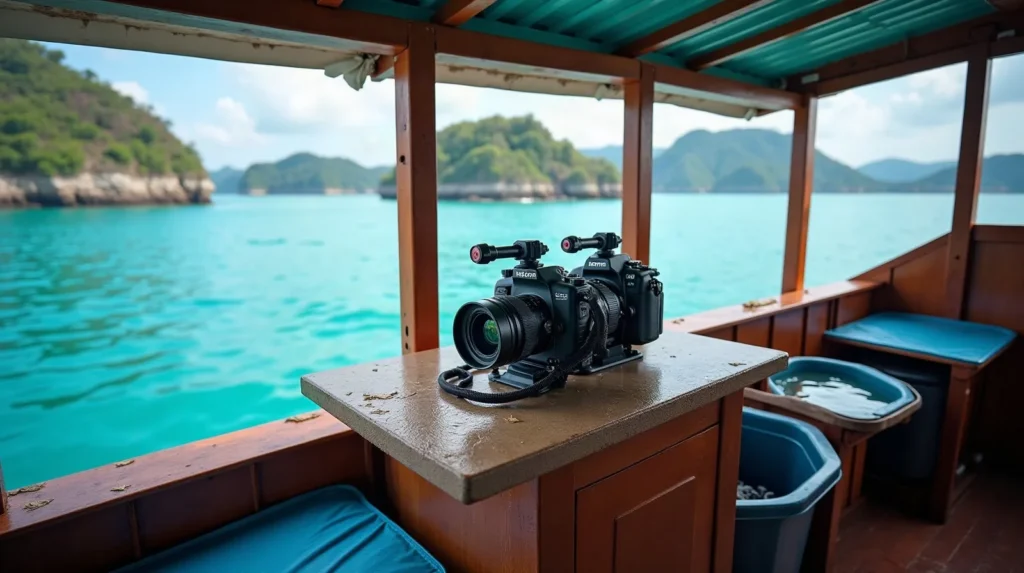
A camera-friendly dive tender deck needs four things the standard layout lacks: a dedicated rinse tank of at least 80–100 litres with fresh water plumbed or jugged for the day, a padded camera table sized for two large housings with raised edges and tie-down points, 12 V and 220 V charging secured in a dry box, and a handling routine that keeps rigs off the deck sole from boat to water and back. In Raja Ampat, where a meaningful share of guests travel specifically to photograph reefs, specifying these at build time costs a fraction of what a single flooded housing costs to replace.
The rinse tank: size, placement, and plumbing
Undersized rinse tanks are the most common photography complaint on tenders. Two large DSLR or cinema housings with strobe arms need 80–100 litres of fresh water to submerge without stacking; a group with six cameras needs either a second tank or a strict rotation. Mount the tank amidships where motion is least, low enough to lift a heavy rig in without a shoulder-height press, and with a drain that empties overboard, not across the deck. On multi-day support work, plumb a deck wash and rinse fill from the main fresh tank; for day boats, two 60-litre lidded tubs lashed in dedicated chocks do the job honestly.
Padding, tables, and where cameras live underway
The camera table belongs under shade, adjacent to the rinse tank, with 40–50 mm closed-cell padding, a 40–60 mm raised lip, and stainless eyes for bungees. Underway in Dampier Strait chop, no rig should sit loose on any surface — the short steep waves described in our sea conditions article will find anything unsecured. Padded, partitioned bins beneath the table let each photographer own a slot. The wider principle is the same one that governs the whole deck: nothing lives on the sole, as set out in the deck layout guide.
Power on deck without corrosion regrets
Photographers arrive with strobe chargers, camera batteries, laptops, and drones. Specify a dry box at the helm console with two 12 V sockets and, on boats with an inverter or generator, two 220 V outlets on a residual-current device. Marine-grade sockets with covers, wiring above bilge level, and a master switch the crew controls. On open tenders, position charging where spray cannot reach even with curtains stowed; a flooded charger has ended more than one trip’s photography.
Entries, exits, and handing rigs
Camera divers enter last and exit first in most protocols, and the deck should support that: a hand-down station at the gate where crew pass rigs to divers already in the water, and a lanyard point at the ladder so rigs come up on a line, not in a climbing diver’s hand. A wide gate and a ladder with flat treads — the same features that serve every diver — matter double with 10 kg of housing involved. These details are drawn into the deck plan when we take a commission through our custom dive tender service.
Retrofitting versus building it in
Every item above can be retrofitted, and all of it costs more that way: tanks end up where space remains rather than where motion is least, wiring runs get compromised, and padding gets glued over surfaces never designed for it. If photography guests are part of your market — and in Raja Ampat they are — put the camera zone in the original deck drawing alongside racks and gates. The main commissioning guide shows where this fits in the overall brief-to-delivery sequence.
Drones, video, and the new equipment aboard
Photography loads have changed shape in five years. Alongside housings, tenders now carry drones that need a clear, level launch surface and a crew briefing about props and rigging; 360 cameras on poles that want vertical stowage; and gimbals whose cases are bulkier than the cameras. The deck answer is flexible: a clear foredeck or cabin-top zone designated for drone operations, two metres of vertical tube stowage for poles, and one deep locker taking hard cases up to airline carry-on size. Power draw has grown too — a serious video group can want 300–400 watt-hours of charging in a day, which sets the house battery and solar sizing on boats without generators.
Charter positioning: why the camera deck pays for itself
Raja Ampat sits on most underwater photographers’ lifetime lists, and photography guests book longer trips, return more often, and choose operators on equipment handling stories told in forums and group chats. A tender that hands rigs down properly, rinses in clean fresh water, and never lets a housing touch bare deck becomes part of an operation’s reputation in a market segment that pays attention. Against that, the build cost of the camera zone — tank, table, padding, power — is one of the highest-return items on the specification sheet. It is why we raise it in every brief, even with owners who do not yet market to photographers.
Frequently Asked Questions
How big should a camera rinse tank be on a dive tender?
Plan 40–50 litres per large housing you expect submerged at once. For a typical Raja Ampat group with two to three big rigs, an 80–100 litre tank or two 60-litre tubs is the working minimum.
Do I need 220 V power on a day tender for photographers?
Not always. Most strobe and camera batteries charge from 12 V adapters or USB-C. Offer clean 12 V sockets in a dry box as the baseline; add inverter-fed 220 V only if the boat already carries a suitable battery bank.
What deck padding material lasts in equatorial sun?
UV-stabilised closed-cell EVA foam, glued and mechanically edged, holds up for years. Lower-grade open-cell foams absorb water and break down within a season under Raja Ampat sun; specify the UV-rated material once and forget it.
Raja Ampat Boat Builder Desk — a specialist maritime brand under Juara Holding Group. Construction contracts issued by PT Komodo Galangan Nusantara. WhatsApp +62 811-3941-4563 · bd@juaraholding.com