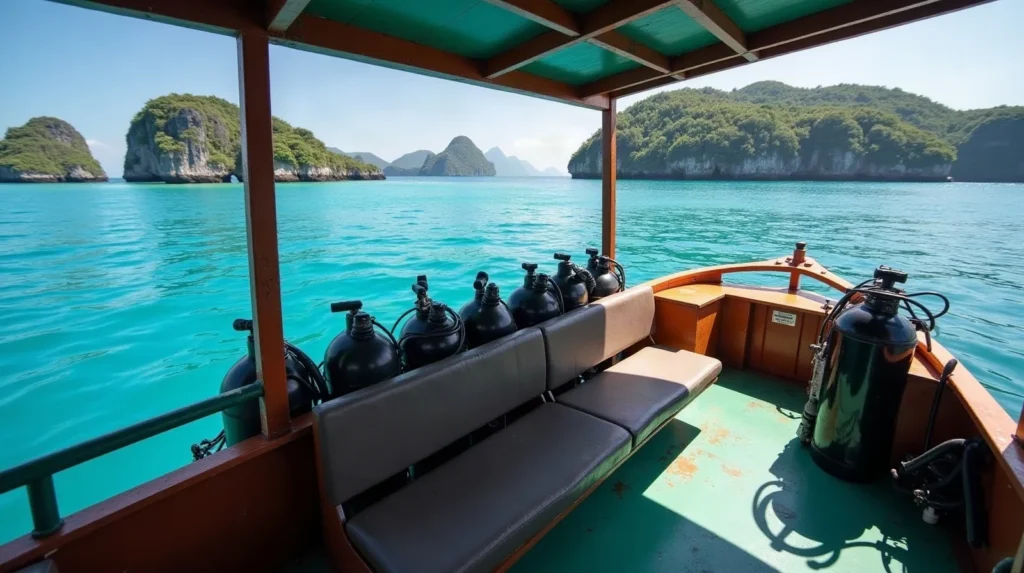
A dive tender deck layout for remote areas like Raja Ampat works when three flows never cross: divers moving aft to enter the water, divers climbing back aboard, and crew handling cylinders. The proven arrangement on 7–12 m tenders is kit-up seating amidships with cylinder racks directly behind each seat, a clear side or transom gate for entries, a ladder recessed so returning divers do not block the gate, and gear stowage forward where weight helps trim. Get those four zones right and the same hull turns divers around in half the time of a poorly arranged one.
Zone one: kit-up seating and tank racks
The seat-with-rack-behind arrangement lets each diver kit up where they sit, without carrying an assembled rig across a moving deck. Seat height matters more than most briefs acknowledge: 45–50 cm lets a diver stand up under a 15 kg rig without help. Racks should hold cylinders vertical or slightly reclined, one strap per tank, with rubber or HDPE lining so aluminium cylinders do not gall against metal. In the Dampier Strait’s short chop, a loose cylinder is the single most dangerous object on deck, which is why we specify racks to restrain tanks through a full roll, not just polite weather.
Zone two: entries — gates, not gymnastics
Backward roll entries from tube or gunwale work on small groups, but a walk-through gate produces faster, calmer entries for eight or more divers. A gate width of at least 70 cm passes a diver with stage bottle; the sill should be low enough that a giant stride is a step, not a leap. Position the gate where the helm can see it — entries happen with engines running near reefs, and eye contact between skipper and divemaster is a real safety control, a point we return to in the full tender specification guide.
Zone three: exits — the ladder decides guest experience
Nothing shapes how guests remember a boat like the climb back aboard after dive three. Specify a ladder that reaches at least a metre below the surface so a diver in fins can get a foot on the bottom rung in surge. Wide, self-draining treads beat round tube rungs; a slope of 10–15 degrees off vertical roughly halves the effort of climbing in full kit. On high-freeboard hulls, a fold-down platform with a short ladder outperforms a long ladder every time. Keep the ladder a metre or more away from the entry gate so returning divers never queue underneath people stepping off.
Zone four: stowage, and keeping the sole clear
Dry bags forward in shelved lockers, weights in low bins near the keel line, spares and oxygen kit in dedicated sealed boxes at the helm. The discipline is simple: nothing lives on the deck sole. In remote operations far from a slipway, gear that slides is gear that breaks — or breaks an ankle. Camera equipment deserves its own padded bench and rinse tank, laid out as described in our camera-friendly deck article.
Shade, water, and the space between dives
Surface intervals in Raja Ampat happen under equatorial sun, often at anchor in a current. A hardtop or rigid canopy over the seating zone, water jugs mounted where divers actually sit, and a dry shelf for phones and logbooks cost little at build time and define the boat’s daily comfort. We integrate all of these choices at the design stage of every custom dive tender we commission, because retrofitting deck hardware after launch always costs more in USD and downtime than drawing it correctly first, as the main commissioning guide explains.
Crew stations: where the divemaster and deckhand actually stand
A layout that works for guests can still fail its crew. The divemaster needs a briefing position where all divers are visible and audible — usually amidships facing aft — with a board or slate stowage at hand. The deckhand needs a working triangle between the racks, the gate, and the ladder that never crosses the guest kit-up flow, plus a dedicated point for handing weights and cameras. The helm needs sightlines to the gate, the ladder, and the bow line without leaving the wheel. On 9–10 m tenders these three stations fit comfortably if drawn early, and collide permanently if left to chance. During deck mock-ups we walk a full simulated dive rotation with the crew roles assigned before any hardware is ordered; twenty minutes of walking finds what weeks of drawing misses.
Materials and maintenance of deck hardware in the tropics
Every rack, hinge, and ladder lives in salt spray and equatorial UV. Specify 316 stainless for fastenings and ladder hardware, anodised or powder-coated aluminium for rack frames, and UV-stabilised HDPE or EVA for linings and treads. Avoid mild steel anywhere on deck, including inside supposedly sealed hinges — it will announce itself in rust streaks within months. Drainage matters as much as material: hardware bases should stand on raised pads so water sheds rather than pooling. A deck specified this way needs a freshwater rinse and a quarterly fastening check, nothing more, for years of daily service in Raja Ampat conditions.
Frequently Asked Questions
How much deck space does each diver need on a tender?
Plan roughly 0.7–0.9 square metres per diver in the kit-up zone, plus rack and walkway space. Twelve divers therefore need a hull in the 10 m class to sit, kit up, and move without crowding.
Should tank racks run along the sides or down the centreline?
Side racks behind seating keep weight outboard and the centre walkway clear, and suit most 7–10 m tenders. Centreline racks suit wider hulls where two seating rows face outboard. The wrong answer is any rack a diver must cross the deck to reach with a loose cylinder.
What is the best diver entry method to design for in Raja Ampat?
Design for walk-through gate entries as primary, with gunwale back-roll as fallback for drift starts. Gates keep groups together in current, which matters at sites where the window to enter over the right spot is short.
Raja Ampat Boat Builder Desk — a specialist maritime brand under Juara Holding Group. Construction contracts issued by PT Komodo Galangan Nusantara. WhatsApp +62 811-3941-4563 · bd@juaraholding.com
Layout errors are the most expensive to fix after lamination — cross-check against the top mistakes when specifying a new dive tender.