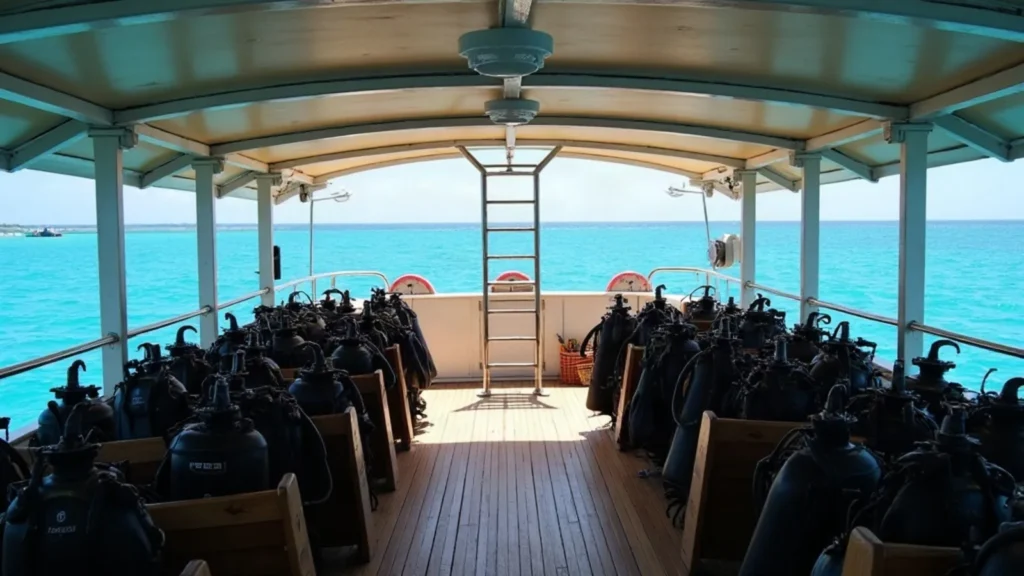
A dive deck is judged by one number: how many minutes it takes to turn a boat around between dives. Everything else — comfort, safety, guest satisfaction — follows from a layout that moves divers and cylinders in one direction without crossing paths. This is how we lay out a Raja Ampat day boat, and which materials survive the conditions.
The principle: one-way flow, one cylinder handling
Draw the diver’s journey before drawing the deck. Guests board, stow dry bags, sit, kit up at their own station, step to the entry point, dive, return via the ladder, de-kit, rinse, and move to shade. If any of those steps requires walking back through the previous one, the deck is wrong.
The same applies to cylinders. A well-designed boat has crew handling each tank once: it sits in the rack where the diver kits up, and the change between dives happens at that station. Boats where tanks are stored forward and used aft generate constant traffic in the narrowest part of the vessel, exactly where people in fins are trying to move.
Tank racks and kit stations
- Individual stations. Each diver gets a numbered seat, a tank position and a hook or cubby for mask, computer and gloves. This alone eliminates most of the chaos on a busy boat.
- Rack height. Cylinders should be liftable into position without a full squat and without lifting above shoulder height. Both extremes cause crew back injuries over a season.
- Positive retention. Bungee alone is not enough in a Dampier Strait chop. Use a physical restraint that holds the cylinder even when the boat rolls hard.
- Drainage under the racks. Standing salt water rots timber and corrodes fittings faster than anything else on a dive boat.
Entry and exit
Boarding is where most day-boat designs fail. The ladder must be wide enough for a diver in fins, immersed deep enough that the first rung is reachable from the water in a swell, and angled rather than vertical. A second ladder is worth the cost on any boat carrying more than twelve divers, because it halves the time in the water at the end of a drift dive — which in a running current is a safety improvement, not just convenience.
The entry point needs a clear, non-slip step and enough deck ahead of it for a diver to do a final check without blocking the queue. Where drift diving is routine, a tender or chase capability changes the whole safety picture. See dive boat new-builds.
Rinse and camera areas
Separate the rinse tanks. One for masks, computers and small kit; a second, larger and cleaner, exclusively for camera housings. Mixing them is how expensive housings get flooded by someone else’s fin strap catching a latch.
Raja Ampat attracts underwater photographers, so the camera table has stopped being optional. What it needs: a padded, drained surface at working height; individual power outlets, generously specified; secure stowage that holds housings through a rough crossing; shade over the table; and enough space that two people can work without touching each other’s gear.
Shade, seating and dry stowage
Divers spend far more time sitting on a boat than diving from it. Shade must cover seated guests at the sun angles you actually operate in, including early morning and mid-afternoon, not just at noon. Bench seating with backrests beats moulded seats for a mixed group in wetsuits, and cushions must drain rather than absorb.
Dry stowage needs to be genuinely dry — sealed lockers, not an area under a tarpaulin. Guests carrying passports, phones and camera bodies notice immediately, and it is one of the lowest-cost quality signals a boat can send.
Decking materials that survive
| Material | Performance | Watch point |
|---|---|---|
| Dense tropical hardwood | Excellent grip wet, cooler underfoot than synthetics, refinishable locally | Needs periodic maintenance and good drainage; sourcing should be legal and documented |
| Synthetic foam decking | Very low maintenance, good grip, comfortable | Retains heat in direct sun; adhesive quality determines lifespan in tropical UV |
| Non-skid painted GRP | Lowest cost, easily repaired, light | Wears in traffic lanes; gets hot; needs periodic recoating |
| Marine plywood with non-skid | Low cost, locally repairable | Shortest life; unforgiving of standing water and poor sealing |
Whichever is chosen, three details determine how long it lasts: drainage that actually clears the deck, sealed fastener penetrations, and a freshwater rinse routine after every trip. Material context is in wood vs aluminium vs fiberglass and hull material options.
Common mistakes
- Tank racks placed where divers must carry cylinders past seated guests.
- A single ladder on a boat running drift dives with sixteen divers.
- Shade sized for the anchored photograph, not for a boat underway at 08:00.
- Camera rinse shared with general rinse.
- No drainage under racks and benches, guaranteeing rot and corrosion.
To lay out a deck around your actual dive schedule, contact +62 811 3941 4563 or bd@juaraholding.com.
Frequently Asked Questions
What decking materials last longest on tropical Raja Ampat dive boats?
Dense tropical hardwood offers excellent wet grip, stays cooler underfoot than synthetics and can be refinished locally. Synthetic foam decking needs almost no maintenance but retains heat. Non-skid painted GRP is least expensive and easily repaired but wears in traffic lanes. Drainage, sealed fastener penetrations and a freshwater rinse routine matter more than the material itself.
How should tank racks be positioned on a dive day boat?
At each diver’s own seating station, so a cylinder is handled once rather than carried across the deck. Rack height should allow lifting without a full squat or reaching above shoulder height, retention must be positive rather than bungee alone, and drainage under the racks is essential.
How many boarding ladders does a dive boat need?
One is workable up to about twelve divers. Above that a second ladder is worth the cost because it halves the time divers spend in the water at the end of a drift dive, which in a running current is a safety improvement rather than a convenience.
Why separate the camera rinse tank?
Because mixing camera housings with masks, fins and computers is how housings get flooded — a strap or buckle catches a latch. A dedicated, larger and cleaner tank for housings only is standard on any Raja Ampat boat carrying photographers.