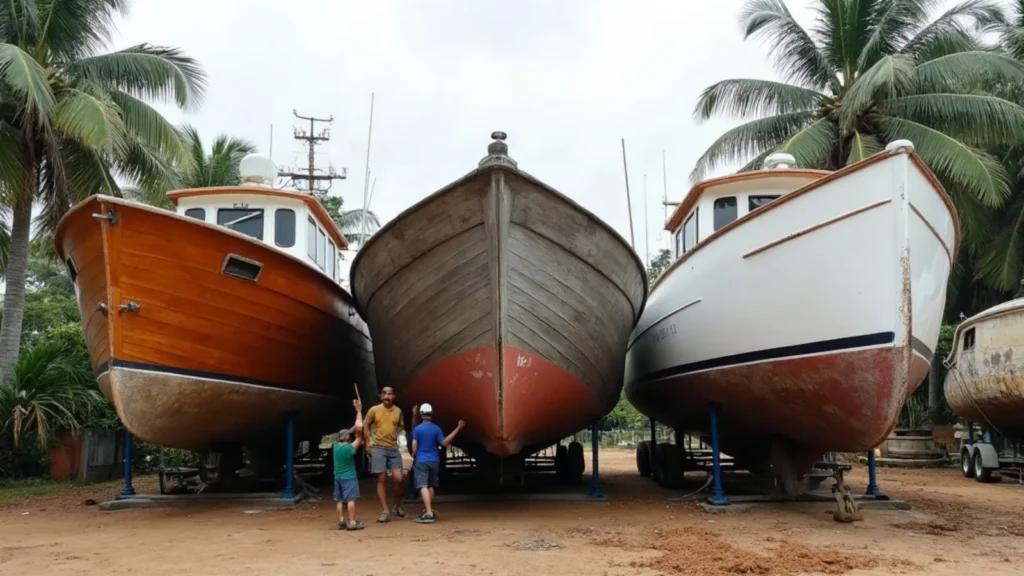
For Raja Ampat, hull material should be chosen on repairability and ten-year cost, not on purchase price. Wood wins for large traditional vessels because it can be repaired locally. Aluminium wins on weight and durability but depends on welders who are scarce in Papua. Fiberglass wins below 20 m and for series builds. This article compares them on the criteria that actually decide the outcome.
The comparison
| Criterion | Wood | Aluminium | Fiberglass / GRP |
|---|---|---|---|
| Build cost, like for like | Moderate, labour-heavy | Highest | Moderate; tooling dominates one-offs |
| Weight | Heavy | Light | Moderate |
| Fuel burn implication | Higher displacement, slower | Best power-to-weight | Good |
| Annual maintenance | High and continuous | Low | Low |
| Repairable in Raja Ampat | Yes — local carpenters | Rarely — certified welders scarce | Partly — materials shippable, skills learnable |
| Cabin heat and noise | Best — timber insulates | Worst without insulation budget | Middle |
| Grounding tolerance | Moderate; repairable damage | High | Moderate; gelcoat and laminate damage |
| Service life, well maintained | 25–40 years | 30+ years | 25–35 years |
| Resale in Indonesia | Strong for traditional vessels | Narrow buyer pool | Broad for small craft |
Lifecycle cost, not purchase price
A wooden hull typically has the lowest or second-lowest build cost per metre in eastern Indonesia and the highest annual maintenance. Aluminium reverses that. Over ten years the totals converge more than owners expect, and the deciding factor is usually not money at all — it is downtime. An operator losing three weeks of high season to a repair has lost more revenue than the maintenance differential across a decade.
That reframes the question: which material fails in a way you can recover from quickly, where you operate? In Raja Ampat, the honest answer for large vessels is timber.
The repairability argument in detail
Damage happens: an unmarked bommie, a jetty in a swell, a log at night. What matters is what happens next.
Wood. A damaged plank can be cut out and replaced by carpenters who already work across eastern Indonesia, using timber that can be sourced regionally. The vessel can often be back in service within days.
Aluminium. A cracked weld or holed plate needs a certified welder with the right process and filler. Those people exist in Indonesia, mostly west of Makassar. Flying one in with equipment turns a two-day repair into a two-week one.
Fiberglass. Laminating repairs sit between the two. The materials ship easily and the skills can be taught to a competent crew, but a structural repair still needs someone who understands laminate schedules.
Comfort: the underrated criterion
Equatorial sun on an uninsulated aluminium deckhouse produces an interior that is genuinely unpleasant, and the noise transmission is worse than most owners anticipate. Aluminium is a fine choice, but the insulation and lining package is part of the material decision, not an optional extra — budget it at the start or regret it every day of operation.
Timber’s natural insulation is a real advantage on a guest vessel. It reduces air conditioning load, which reduces generator hours, which reduces fuel cost and noise. On a liveaboard where guests sleep aboard for twelve nights, this compounds. See air conditioning design.
Decking, separately
Deck material is a distinct decision from hull material. Dense tropical hardwood decking performs well underfoot, stays cooler than synthetics in direct sun, and can be refinished locally. Modern synthetic decking resists UV and needs almost no maintenance but retains heat, which matters where divers and snorkellers walk barefoot. Whatever is chosen, drainage and wet grip outrank appearance. Detail: designing the ideal dive deck.
Choosing, in practice
- 25 m+ expedition liveaboard, traditional form, remote itineraries: wood, with a disciplined maintenance regime.
- Fast crew or transfer boat holding a schedule: aluminium if welding support can be arranged, otherwise GRP.
- Day dive boat or snorkel boat under 20 m: GRP, or timber composite where local repair capability matters most.
- Two or more identical boats: GRP, because tooling cost amortises.
- 35 m+ with higher passenger counts and insurer scrutiny: steel becomes a serious option.
- Ranger, patrol or survey craft with hard use and grounding risk: aluminium.
Material is chosen after the operating profile, never before. Service-page detail is on hull material options, and the vessel pages that depend on it are liveaboard builds and speedboats and tenders. To discuss a specific project, contact +62 811 3941 4563 or bd@juaraholding.com.
Frequently Asked Questions
Is aluminium a good choice for a Raja Ampat boat?
Yes for fast crew boats, patrol craft and light dive boats where weight and durability matter, provided welding support can be arranged and an insulation budget is included. Certified aluminium welders are scarce east of Makassar, so plan repair access before committing.
Why do large Raja Ampat liveaboards still use wood?
Because damage can be repaired locally. Carpenters capable of replacing planking work across eastern Indonesia, so a grounding far from a major port does not automatically mean a long lay-up. Timber also insulates against heat and noise, which reduces air conditioning load on guest vessels.
Which material has the lowest lifetime cost?
Over ten years the totals converge more than owners expect. Wood is less expensive to build and more expensive to maintain; aluminium reverses that. The decisive cost is usually downtime rather than maintenance, which favours whichever material can be repaired quickly where you operate.
What decking material lasts longest on tropical dive boats?
Dense tropical hardwood performs well, stays cooler underfoot than synthetics in direct sun and can be refinished locally. Synthetic decking resists UV with minimal maintenance but retains heat. Drainage and wet grip matter more than the material choice itself.