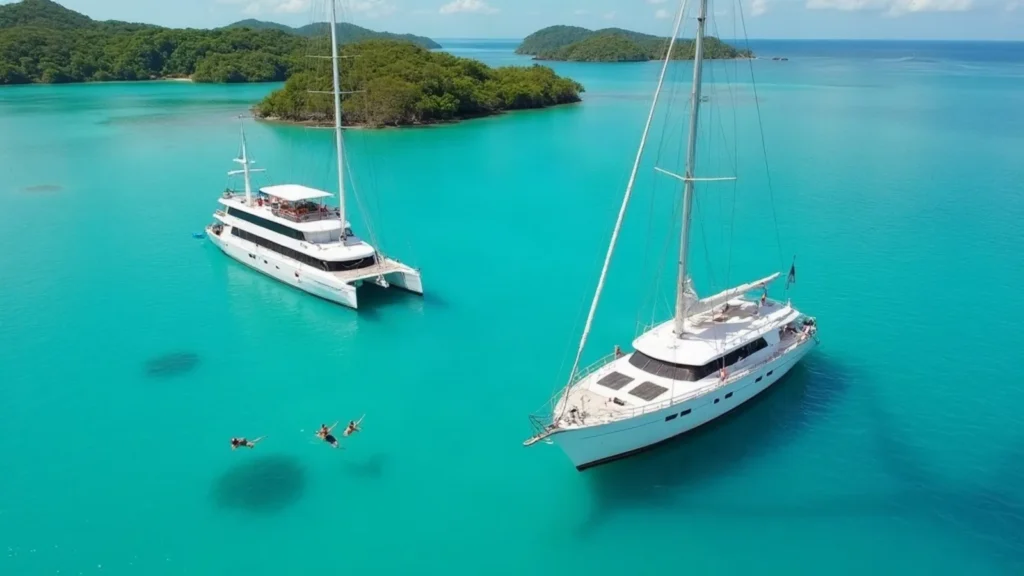
For Raja Ampat snorkel day trips, a catamaran gives roughly twice the usable deck per metre of length, minimal roll at anchor and shallower draft; a monohull costs less per metre, handles head seas more softly, and is far easier to berth and repair locally. Neither is universally right. The decision comes from your routes, guest numbers and where the boat will be maintained.
Where the difference actually shows
| Factor | Catamaran | Monohull |
|---|---|---|
| Usable deck per metre | Roughly double | Limited by beam |
| Roll at anchor | Minimal — the main selling point | Noticeable in any swell |
| Draft | Shallow; good lagoon and beach access | Deeper for equivalent capacity |
| Head-sea motion | Can slam under the bridge deck | Generally softer and more predictable |
| Fuel burn at cruise | Efficient at moderate speed, sensitive to weight | Predictable, tolerant of load |
| Build cost per metre | Higher — two hulls, two engine installations | Lower |
| Berthing and slipping | Beam restricts options | Accommodated everywhere |
| Local repair familiarity | Less common in eastern Indonesia | Universally understood |
| Guest perception | Modern, spacious, premium | Traditional, familiar |
The case for a catamaran
Snorkel operations sell deck, not knots. Guests spend the day getting in and out of the water, eating, drying off and lying in the sun. A catamaran turns the same length of boat into substantially more of that, and does it without the roll that makes lunch service and nervous swimmers difficult on a monohull at anchor.
Shallow draft is the second real advantage. Much of what makes Raja Ampat commercially valuable — lagoons, sheltered bays, beach landings, mangrove channels — sits in water that penalises deep hulls. A catamaran can take guests where a keeled monohull of the same capacity cannot, which is a revenue argument rather than a comfort one.
Multihulls also suit low-noise operation, which matters for birdwatching and wildlife work and pairs naturally with hybrid or electric propulsion. See planning a low-noise electric catamaran.
The case for a monohull
Cost per metre is the obvious one: one hull, one engine installation, one set of systems. For an operator whose economics are tight, that difference can be the whole margin.
Beyond cost, three practical arguments favour monohulls in this region. They handle a head sea more softly, which matters on exposed crossings. They can be slipped, berthed and hauled anywhere, whereas beam limits a catamaran’s options. And every boatyard and mechanic in eastern Indonesia understands them, which shortens every repair.
There is also a weight-sensitivity issue. Catamarans degrade noticeably when loaded beyond design displacement, and operators who add generators, water tanks and equipment over the years often find performance and motion deteriorating. A monohull absorbs added weight more gracefully.
Bridge deck clearance: the decision that ruins bad catamarans
If you build a catamaran, the single most important number is bridge deck clearance — the gap between the water and the underside of the structure joining the hulls. Too little, and the boat slams under the wing in a chop: loud, uncomfortable, and hard on the structure. It is the most common multihull design failure and it cannot be fixed afterwards. Adequate clearance costs freeboard and windage, so it is a genuine trade-off that has to be made deliberately at concept stage.
Choosing by operation
- Sheltered snorkel days, 20–40 guests, lagoon and beach access, premium positioning: catamaran.
- Mixed snorkel and dive with exposed crossings, tight budget, local maintenance: monohull.
- Wildlife, birdwatching, photography charters needing quiet and stability: catamaran, potentially hybrid.
- Multi-purpose boat also carrying cargo or crew: monohull.
- First boat for a new operator: monohull, almost always — lower capital risk and easier to maintain and resell.
The question nobody asks early enough
Where will the boat be maintained in year three? Multihulls need a haul-out facility that can accept the beam, and those are limited in eastern Indonesia. If the realistic answer is that the vessel will be careened on a beach or worked afloat, a monohull is the lower-risk choice regardless of how attractive the deck area looks in year one. This single question resolves more catamaran-versus-monohull debates than any performance comparison.
Budget comparison
A 14–16 m day-charter catamaran runs roughly USD 200,000–380,000; a monohull day boat of comparable passenger capacity typically sits USD 90,000–260,000. The premium buys deck area, stability and draft — assess whether your pricing can actually recover it. Detail: catamaran new-builds, Waisai day boats and pricing and investment.
To model both options against your routes and guest numbers, contact +62 811 3941 4563 or bd@juaraholding.com.
Frequently Asked Questions
Is it better to build a catamaran or monohull for Raja Ampat snorkel trips?
A catamaran gives about twice the usable deck per metre, minimal roll at anchor and shallower draft, which suits snorkel day charter. A monohull costs less per metre, handles head seas more softly, berths and slips anywhere, and is understood by every local repairer. The right answer depends on routes, guest numbers, budget and where the boat is maintained.
What is the cost difference between a catamaran and a monohull day boat?
A 14 to 16 m day-charter catamaran runs roughly USD 200,000 to 380,000. A monohull day boat of comparable passenger capacity typically sits between USD 90,000 and 260,000. The premium buys deck area, stability at anchor and shallower draft.
What is the most important design number on a catamaran?
Bridge deck clearance — the gap between the water and the underside of the structure joining the hulls. Insufficient clearance causes slamming under the wing in a chop, which is uncomfortable, noisy and structurally punishing, and it cannot be corrected after the boat is built.
Which is better for a first-time operator?
Usually a monohull. Lower capital cost, easier local maintenance, wider berthing and slipping options and a broader resale market all reduce the risk on a first vessel.