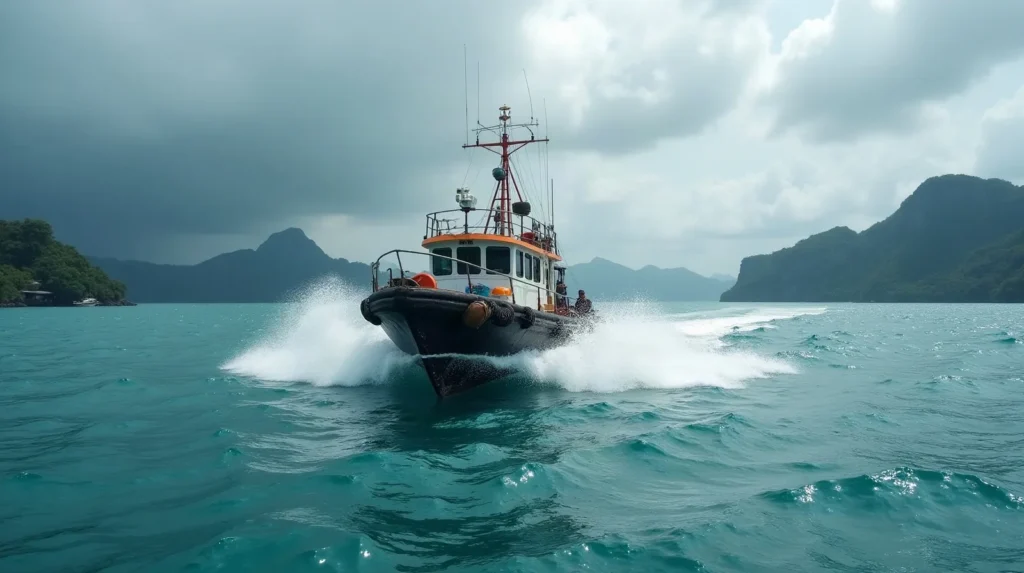
The Dampier Strait — the passage between Sorong and Waisai that nearly every Raja Ampat boat must cross — is defined by strong tidal streams meeting monsoon-driven wind, producing short, steep, confused chop rather than long ocean swell. For a boat builder the planning conditions are: current that can run to several knots through the constriction, wind-against-tide seas commonly in the 1–1.5 m band with occasional worse, squalls that arrive fast and pass within the hour, and a daily pattern of calm mornings deteriorating into rough afternoons. Boats specified for this water need a fine entry, generous freeboard forward, self-draining decks, and power reserve to hold schedule when the strait says otherwise.
The mechanics: why this water is short and steep
The strait funnels tidal flow between the Bird’s Head Peninsula and Waigeo, accelerating it. When that stream opposes the wind, wave length compresses and wave faces steepen — classic wind-against-tide behaviour, familiar from tidal straits worldwide but served here with equatorial squall systems on top. The result is a sea that is rarely dangerous for a well-found boat but is relentlessly uncomfortable for a badly shaped one: crests close together, faces steep, direction confused where streams eddy behind islands. Long-period ocean swell, by contrast, is largely filtered by the surrounding archipelago.
What the daily and seasonal patterns mean for operations
Mornings are the friend of every operator here: wind is commonly light before mid-morning, and most transfer schedules are built around it. Afternoons bring convection, sea breeze, and squalls. Seasonally, the south-east monsoon months (roughly mid-year) bring the strongest persistent winds and the roughest strait crossings, while the north-west season brings squally, less predictable weather. Builders should assume the boat will sometimes be caught out in the afternoon regardless of planning — and specify for the crossing the schedule forces, not the crossing the brochure imagines. Fuel consequences of that honesty are quantified in the Sorong–Waisai fuel planning article.
Hull form answers to a short steep sea
Three design features earn their keep in this specific water. A fine, deep entry forward — the variable-deadrise geometry discussed in the deadrise article — lets the bow slice crests rather than slam them. Freeboard and flare forward keep green water and spray out of a boat that will take seas near head-on twice a day. And self-draining decks with honest scupper area handle the boarding sea or squall dump without drama. Speed helps too, counterintuitively: a hull with reserve power can often find a speed that phases comfortably with the wave pattern, where an underpowered boat is stuck matching it badly.
Beyond the hull: the systems the strait tests
Windscreens and canopies must survive repeated spray loading; flimsy frames work loose in a season. Electronics and charging points need real spray protection — the dry-box standards described in the camera deck article apply to the whole helm. Engine reliability is non-negotiable in a waterway with commercial traffic and current; the redundancy case in the twin-versus-single article is written substantially with this strait in mind. Every one of these items is less costly specified at build time, which is why the strait sits at the centre of the Raja Ampat commissioning guide and the range planning on our logistics page.
Current seamanship: working the stream instead of fighting it
Local skippers treat the strait’s tide as a conveyor to be used. Departures timed to a favourable stream add a knot or two of ground speed for free; the same passage forced against the flow burns the difference in fuel and comfort. Around headlands and between islands, back-eddies offer smoother water and slacker current for a boat willing to route a few hundred metres off the direct line. For builders the lesson is indirect but real: a boat with modest draft, responsive steering, and good visibility lets a skipper use this micro-routing; a deep, ponderous hull surrenders the option. Crew training should include a season’s apprenticeship of tide-table reading for the specific crossing times the operation runs.
Squall protocol: ninety minutes of weather, drawn on the boat
Squalls here are violent, brief, and survivable by procedure. The protocol worth building the boat around: watch the western and northern horizons after midday; at first sight of a dark line, secure loose gear and deploy side curtains; decide early to run for a lee, anchor in sand clear of coral, or take the squall bow-on with power in open water; expect a wind spike, a blinding rain band, and calm within the hour. The build consequences are concrete — curtains that deploy in two minutes, an anchor and rode sized for sudden holding, self-draining decks that shed the rain load, and wipers or clear-view arrangements at the helm. Boats specified this way treat squalls as weather; boats that were not treat them as events.
Frequently Asked Questions
How rough does the Dampier Strait actually get?
Typical working conditions are wind chop up to about 1–1.5 m, short and steep when wind opposes tide; squalls and strong monsoon days produce worse for limited periods. It is demanding small-boat water rather than dangerous water — provided the boat was designed for it and the crew respects the afternoon pattern.
What time of day is best to cross from Sorong to Waisai?
Morning, as early as schedule allows. Wind and convection typically build after midday, and the roughest crossings cluster in the afternoon. Operators who can hold morning departure discipline cancel far fewer trips.
Should a boat for this crossing be bigger, or just better shaped?
Shape first, then size. A well-designed 9–10 m hull with a fine entry and dry topsides handles the strait better than a poorly shaped 12 m barge. Length adds comfort mainly by bridging more of the short wave pattern — useful, but no substitute for the right sections.
Raja Ampat Boat Builder Desk — a specialist maritime brand under Juara Holding Group. Construction contracts issued by PT Komodo Galangan Nusantara. WhatsApp +62 811-3941-4563 · bd@juaraholding.com