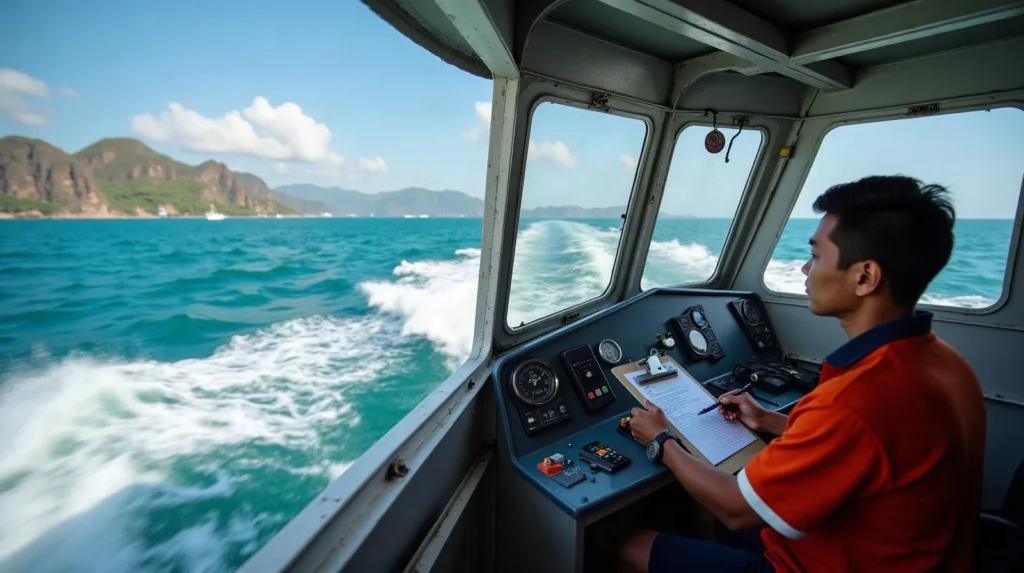
Sea trials before delivery to Raja Ampat test one question under load: will this boat do its job at its real operating weight, far from the yard that built it? A proper trial programme runs the boat at full working displacement — not empty — and verifies speed and fuel burn against the specification, engine temperatures and trim behaviour through the range, handling and spray in real chop, stability in representative loading cases, every system from bilge pumps to navigation lights, and, for tenders, the dive-specific hardware: gates, ladders, racks under way. Defects found at trials are yard problems; the same defects found in the Dampier Strait are your problems, several days’ passage from the builder.
Trial one: performance at honest displacement
The single most common trials shortcut is running light. Insist the boat carries ballast equal to full operating load — passengers, cylinders, fuel, water, spares, honestly counted per the specification guide. Then log a measured-mile series: speed and fuel flow at intervals from idle to maximum, with GPS runs in both directions to cancel current. The output is the boat’s real litres-per-mile curve — the number every fuel plan in its working life will stand on, as used in the Sorong–Misool fuel calculation. If loaded performance misses specification, that is a contract conversation now, not a discovery later.
Trial two: engines, systems, and the ugly details
Through the speed series, log engine temperatures, oil pressure, and charging voltage; any drift signals cooling or installation faults. Run each engine of a twin installation alone at load, confirming the single-engine get-home performance promised in the redundancy article. Test every pump with water actually in the bilge, every light after dark if schedule allows, the anchor windlass under real load, steering hard-over at speed, and fuel gauge accuracy against known quantities. Trials are also when wiring and plumbing workmanship shows — vibration finds unclamped runs within an hour.
Trial three: the dive deck under way
For a dive tender, the deck is the product. With the boat moving and moored: open and close gates in chop, climb the ladder in swim gear repeatedly, load and unload cylinders from racks, confirm racks restrain tanks through aggressive manoeuvres, flood-test the camera rinse tank arrangement, and walk the guest flow from boarding to entry to exit looking for the crossing points that the deck layout guide warns against. Ten divers’ worth of choreography rehearsed at the yard costs an afternoon; discovering a blocking ladder at a Misool site costs every trip until it is rebuilt.
Documentation, defects, and the delivery decision
Everything gets written: a trials report with the performance curves, a defect list graded blocking versus snag, photographs, and sign-offs. Blocking defects — performance shortfalls, overheating, stability doubts, safety-equipment gaps — hold the final payment stage under the contract structure described in the staged payments article. Snags get a rectification schedule with retention money behind it. Only then does the delivery voyage north get planned — itself a shakedown of range, spares, and crew familiarity. This trials-and-acceptance gate is a fixed stage of the commissioning process and of our Papua commissioning service, because it is the last point where fixing things is straightforward.
The delivery voyage as the final trial
Between the yard and Sorong lies a passage of several days that is itself the last and most honest trial. Plan it as one: full spares kit aboard and inventoried, crew who will operate the boat making the passage to learn her, a leg structure with bail-out ports identified, and a log kept of fuel burn, engine temperatures, and every snag however small. The delivery reveals what two days of trials cannot — how the boat behaves in a real seaway for ten hours, whether the helm seat is honest, which locker leaks in driven spray. Snags found on delivery still fall under warranty and retention; the log is the evidence. A boat that arrives in Sorong with a clean delivery log and a satisfied crew is commissioned in the only sense that matters.
Handover: turning trials results into operating documents
Acceptance is not the end of the paperwork; it is the conversion of trials data into the boat’s operating library. The handover pack we assemble holds the loaded performance curves and litres-per-mile card for the helm, the stability notes in plain language, engine service schedules aligned to a calendar, the anode and keel-shoe inspection sheet, the spares inventory, and the warranty contacts with the paper trail that keeps cover alive. Crews trained during trials and delivery sign onto the documents they helped create. Owners sometimes ask why a small boat needs a library; the answer is that the boat will outlast every crew change, and the library is how the next crew inherits the first crew’s competence.
Frequently Asked Questions
How long do proper sea trials take for a new tender?
Plan two to three days: one for loaded performance and engine series, one for systems and deck trials, and margin for re-tests after adjustments. Compressing trials into a two-hour demonstration run is how defects ride to Raja Ampat undetected.
Who should attend sea trials for the buyer?
Someone technically competent who answers to the buyer, not the yard — an independent supervisor or surveyor, plus ideally the skipper who will operate the boat. The operating crew learns the vessel; the supervisor holds the specification against the results.
What if trials reveal the boat is slower than specified?
First diagnose: propeller pitch, trim, weight over budget, and engine setup account for most shortfalls and are correctable. If the shortfall is genuine hull performance, the contract’s specification annex and retention become the leverage for remedy — which is precisely why the specification was signed and the money staged.
Raja Ampat Boat Builder Desk — a specialist maritime brand under Juara Holding Group. Construction contracts issued by PT Komodo Galangan Nusantara. WhatsApp +62 811-3941-4563 · bd@juaraholding.com