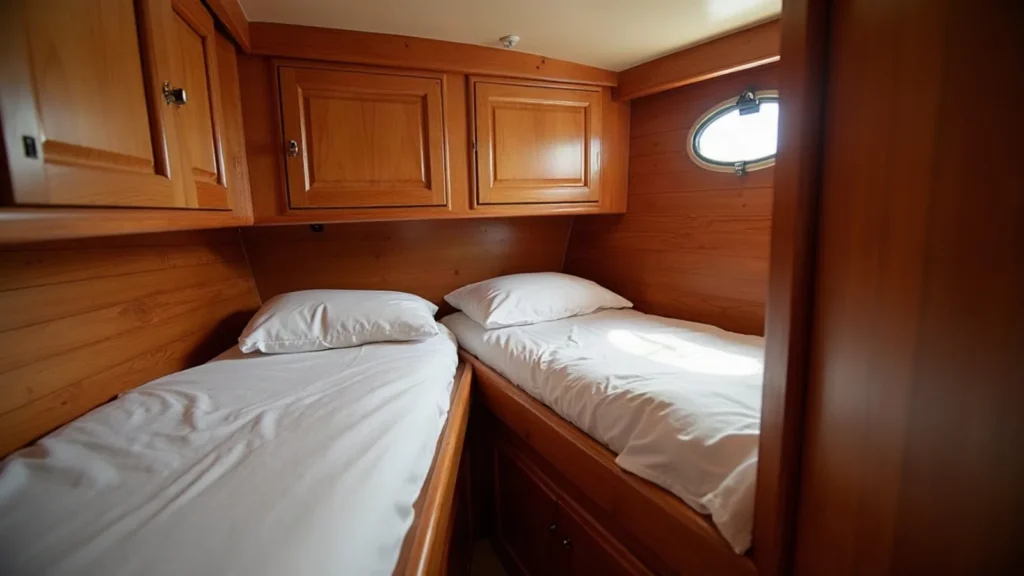
Cabin count is a revenue decision disguised as a layout decision, and it should be made from occupancy assumptions rather than from how many berths fit. Costs step rather than slope: crossing certain guest thresholds adds crew, tenders, compressors and generator capacity all at once. Building one cabin past a threshold you cannot reliably fill is one of the most expensive mistakes in liveaboard design.
Start from berths you can actually sell
The right question is not “how many cabins fit in 30 metres” but “how many berths can we sell at our target rate in a realistic season”. Multiply berths by realistic occupancy by operating days to get sold berth-nights, then check whether that revenue supports the vessel you are drawing.
Two vessels of identical length can have very different economics. A 30 m boat with six spacious ensuite cabins serving a premium segment can out-earn the same hull with ten tight cabins chasing volume — with lower crew cost, lower food and fuel per guest, and a better guest experience. Which is right depends entirely on the market you can actually reach. See investment analysis.
Where the cost steps happen
| Threshold | What it typically triggers |
|---|---|
| ~12 guests | Second dive tender; larger compressor capacity; additional dive crew |
| ~16 guests | Additional crew cabins; larger galley and provisioning; more generator capacity |
| ~20 guests | Materially larger vessel; higher certification and safety-equipment requirements; larger crew complement |
These are indicative rather than regulatory, but the pattern holds: the marginal cabin that crosses a threshold is far more expensive than the one before it. If your occupancy model does not comfortably fill it, do not build it.
Cabin mix
Dive liveaboard guests arrive as couples, as solo travellers, and as buddy pairs sharing. A workable mix on a mid-size vessel typically includes a small number of larger cabins with a double bed, a majority of twin cabins convertible to double, and one or two smaller cabins that price attractively for solo or budget-conscious divers.
What consistently matters more than cabin size: ensuite quality, air conditioning that is quiet enough to sleep through (HVAC design), reading lights that work for two people independently, enough power outlets for camera batteries, and stowage for dive gear and luggage. Guests forgive a compact cabin; they do not forgive a noisy or hot one.
Position matters as much as size
- Motion. Cabins nearest amidships and lower have the gentlest motion, and should be allocated to guests most likely to be sensitive.
- Noise. Cabins adjacent to the engine room, generator space, compressor room or anchor windlass need serious insulation, or should not be guest cabins at all.
- Route to the dive deck. Guests kit up several times a day. A cabin requiring passage through the saloon in a wet wetsuit creates constant friction.
- Crew separation. Crew need their own access routes and mess space so that service does not run through guest areas.
Do not squeeze the dive deck
The strongest temptation in liveaboard layout is to take space from the dive deck to add a cabin. It is almost always the wrong trade. The dive deck determines how quickly the boat turns around, how safe entries and exits are, and how much guests enjoy the operation — which drives reviews, which drives occupancy, which drives the whole model. See dive deck design.
The same applies to shaded social space. On a twelve-night trip guests spend far more waking hours in the saloon and on the sun deck than in their cabins.
Crew accommodation is not a rounding error
Crew quality is the single largest determinant of guest satisfaction on a dive liveaboard, and crew retention depends heavily on their living conditions. Cramped, hot, badly ventilated crew quarters produce turnover, and turnover produces inconsistent service. Budget proper crew cabins with air conditioning, adequate stowage and a mess area separate from working spaces. It is a commercial investment, not a cost.
Test the arrangement before it is fixed
Before the general arrangement is frozen, walk the vessel on paper as a guest: wake, shower, breakfast, kit up, dive, return, rinse, camera work, lunch, rest, second dive, dinner, bed. Then walk it as crew: provisioning, service, laundry, tank filling, guest assistance, cleaning. Any point where those paths collide repeatedly is a design fault that will annoy people every day for twenty years.
Full context: liveaboard new-builds, technical specifications and pricing and investment. To review a general arrangement against your occupancy model, contact +62 811 3941 4563 or bd@juaraholding.com.
Frequently Asked Questions
What occupancy assumptions should drive cabin count on a Raja Ampat liveaboard?
Work from berths you can realistically sell at your target rate: berths multiplied by realistic occupancy multiplied by operating days. Costs step at roughly 12, 16 and 20 guests as tenders, compressors, crew and generator capacity are added, so a cabin that crosses a threshold you cannot reliably fill is disproportionately expensive.
Is it better to build fewer large cabins or more small ones?
It depends on the market you can actually reach. Fewer, larger ensuite cabins serving a premium segment can out-earn a volume layout on the same hull, with lower crew, food and fuel cost per guest. A volume layout only wins if you can reliably fill it.
What matters more to guests than cabin size?
Ensuite quality, air conditioning quiet enough to sleep through, independent reading lights, enough power outlets for camera batteries, and proper stowage for dive gear and luggage. Guests forgive a compact cabin but not a hot or noisy one.
Should dive deck space be reduced to fit another cabin?
Almost never. The dive deck determines turnaround speed, entry and exit safety and guest enjoyment, which drives reviews and therefore occupancy. Taking space from it to add a berth usually costs more revenue than the berth generates.