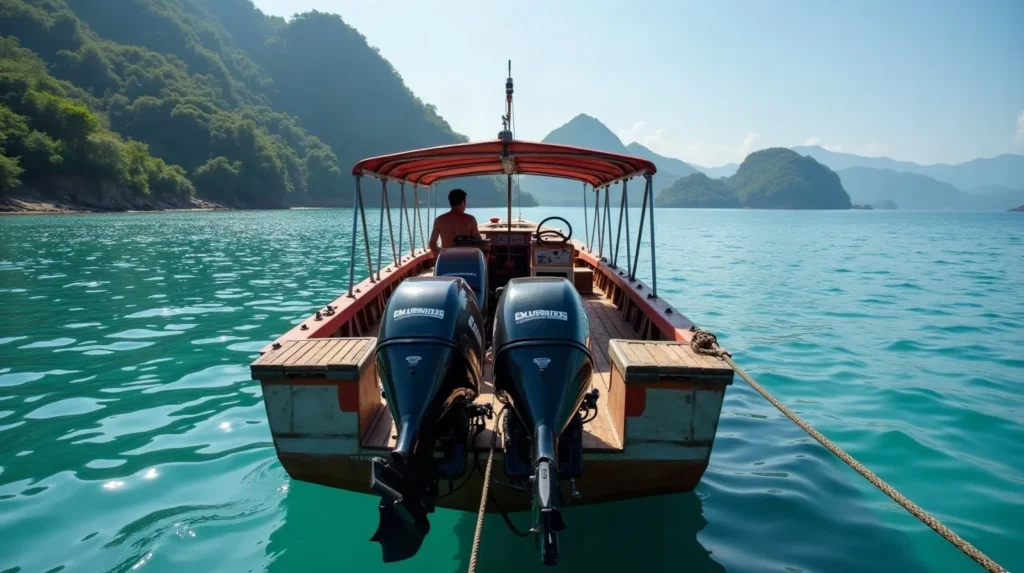
In remote waters the twin-versus-single outboard question resolves to this: a twin installation converts an engine failure from an emergency into an inconvenience, and for boats carrying guests beyond quick rescue range in places like Raja Ampat, that conversion is usually worth its cost. Twins price higher in USD, burn several percent more fuel, and double routine servicing; a single is simpler and more efficient but makes the boat a drifting object the moment it stops. The honest decision weighs your distance from help, your schedule obligations, and your discipline about maintenance — not the look of the transom.
What failure actually looks like out here
Between Sorong and the outer islands, a dead engine means drifting in current with limited VHF coverage, patchy phone signal, and other vessels that may be hours away. With guests aboard, sun, seasickness, and schedule collapse compound fast. A second engine — even run home slowly at displacement speed — turns that scene into a late arrival. This is the context that makes redundancy a specification issue rather than a preference; the same regional realities shape the fuel planning in our Sorong–Waisai range article.
The real costs of twins, counted
Two engines of half the power cost more in USD than one of full power — typically 15–30 percent more for the package plus rigging. Servicing doubles: two sets of filters, impellers, gear oil, anodes. Fuel burn at cruise runs a few percent higher from the extra lower-unit drag and weight. Transom loading increases, which the structure must be designed for. None of this is trivial on a working budget, and pretending twins are free is how briefs go wrong; the sizing logic behind these numbers sits in the outboard selection guide.
What twins must be, to be real redundancy
Redundancy is a system, not a second engine. Each engine needs its own fuel line, primary filter, and ideally its own tank pickup, so contaminated fuel cannot kill both. Batteries and starting circuits must be separated with a cross-connect for emergencies. Each engine alone must push the loaded boat to steerage and modest cruise — check the single-engine performance at full displacement, not brochure weight. And crews must actually practice single-engine running, including how the boat handles asymmetric thrust near reefs.
When a single engine is defensible
A single makes sense for boats operating inside protected lagoon systems near their base, for craft that always travel in company with another vessel, and for budget-constrained operations that would otherwise defer maintenance on twins — a well-maintained single beats two neglected engines. If you run a single in remote service, the specification should compensate: premium fuel filtration, rigorous preventive maintenance, an auxiliary bracket with a small get-home outboard where practical, satellite communications, and honest route limits. These mitigations belong in writing in the boat’s operating plan, a document we draft with owners during the commissioning process.
Our specification defaults
For dive tenders and transfer boats running guests across the Dampier Strait or south toward Misool, we specify twins as default. For lagoon workboats and short-hop homestay craft, singles with a documented contingency are common and reasonable. Either way the decision is recorded with its reasoning in the specification sheet, alongside the deck, hull, and range choices covered across our custom dive tender service.
Handling qualities: what twins change at the helm
Redundancy is the headline, but twins also change how the boat handles every day. Differential thrust turns a 10 m tender in its own length at a mooring, holds station against current at a reef pickup without constant helm, and backs down straight when recovering a drifting diver — small competencies that add up to calmer operations in exactly the tight, current-swept places Raja Ampat specialises in. The costs at the helm are wider turning transoms, more levers to manage, and asymmetric behaviour when one engine trims or fouls. Crews stepping up from singles need a day of deliberate practice; after that, most refuse to go back. Build that practice day into the delivery plan so the skills exist before the first guests board.
Insurance, charters, and what the market expects
Commercial context increasingly settles the question regardless of engineering preference. Insurers quoting guest-carrying operations in remote Indonesian waters commonly ask about propulsion redundancy and communications when setting terms; charter agencies and international dive operators booking boats for their groups ask the same in their vetting sheets. A twin-engined, properly filtered, satellite-equipped tender passes those conversations without friction. None of this makes singles impossible — but an owner choosing a single for sound local reasons should document the contingency plan formally, because the question will be asked by underwriters and partners who were not in the room when the choice was made. A one-page contingency annex in the operating plan answers it cleanly and keeps the single-engine option commercially respectable.
Frequently Asked Questions
Can one engine of a twin pair get a loaded boat home?
A properly sized pair, yes — expect displacement-to-semi-planing speeds, roughly 6–10 knots loaded, with sluggish but workable handling. Verify this during sea trials at full load rather than assuming it; it is a standard test in our delivery trials.
Is a small auxiliary outboard a substitute for twins?
Partially. A 15–20 hp auxiliary will bring a mid-size tender home slowly in calm conditions, and is far better than nothing. Against current and chop with a full load, its limits show quickly. Treat it as a mitigation for protected-water singles, not an equivalent to twins.
Do twins need to be the same model and age?
Yes, in commercial service. Matched engines share props, spares, filters, and mechanic familiarity, and balance thrust cleanly. Mixed pairs complicate everything the redundancy was meant to simplify.
Raja Ampat Boat Builder Desk — a specialist maritime brand under Juara Holding Group. Construction contracts issued by PT Komodo Galangan Nusantara. WhatsApp +62 811-3941-4563 · bd@juaraholding.com