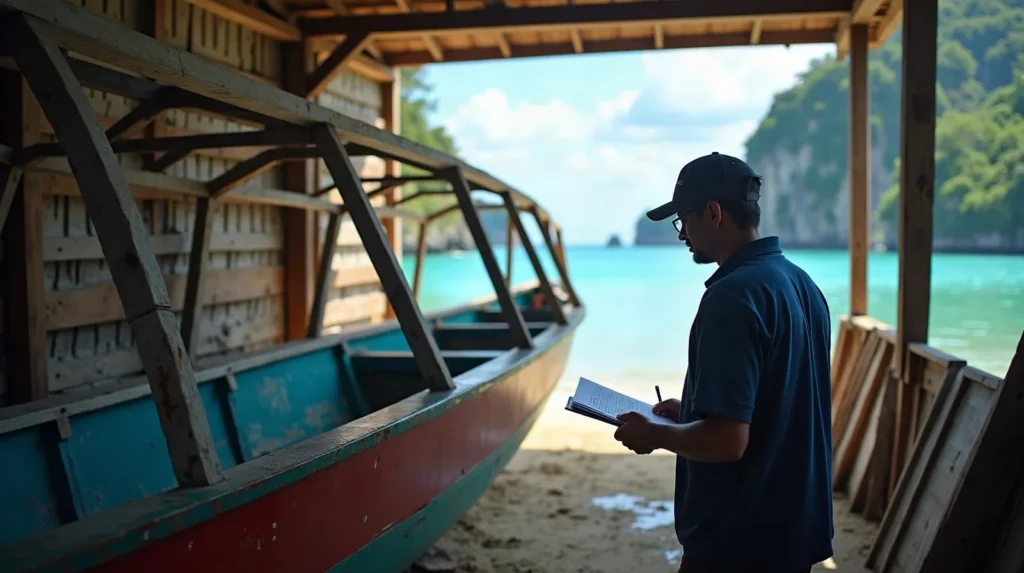
Staged payments at Indonesian yards follow a simple protective principle: money moves only after inspected, documented milestones — never ahead of them. A typical structure for a custom small-craft build is 20–30 percent on contract signing to fund materials, 20–25 percent at hull completion, 20–25 percent at engine and systems installation, 15–20 percent after successful sea trials, and a 10 percent retention at delivery and acceptance. Each release ties to a defined, verifiable state of the boat, confirmed by someone acting for the buyer — and the contract, in writing, is what makes that sequence enforceable rather than polite.
Why stage structure matters more at remote distance
Most owners commissioning boats for Raja Ampat are not standing in the yard weekly — the yards with the right skills and pricing are typically in Java, Sulawesi, or Batam, days from the boat’s future home. Distance amplifies the classic risks: payments drifting ahead of progress, specification drift, quality hidden under paint, schedule slip discovered too late. The staged structure is the financial control; independent inspection at each stage is the information control. The two only work together — a milestone nobody verifies is just a date on an invoice.
What the contract must actually contain
Beyond price and dates, insist on: the technical specification as a signed annex — the document built through a proper designer brief; the payment schedule with milestone definitions in inspectable terms (“hull plating complete and welded per drawing”, not “hull stage”); a change-order procedure requiring written agreement on cost and schedule before work proceeds; ownership and insurance of the part-built vessel and of buyer-supplied equipment; warranty terms with duration and scope; and a delay regime with agreed remedies. Currency should be fixed — USD is standard for foreign buyers, with government fees stated factually in IDR where they arise.
Inspections: what gets checked at each release
At hull stage: dimensions against drawings, plate or laminate quality, weld or lamination inspection, weight against budget — the drift problem quantified in the hull weight article. At systems stage: engine installation, fuel system integrity and filtration, wiring standard, and the galvanic isolation details from the corrosion protection guide. At trials stage: the full protocol described in the sea trials article, loaded, documented, and signed. The retention releases only when defects found at trials and delivery are closed out.
How supervision fits, honestly framed
Our role in this structure is coordination and supervision: we help owners select the partner yard suited to the material and design, hold the specification, attend the milestone inspections, verify each payment release, run the trials, and manage delivery north to Sorong. We do not ask owners to pay against progress they cannot see; the entire system exists so that every USD released corresponds to inspected reality. Construction contracts in our ecosystem are issued by PT Komodo Galangan Nusantara, and the full sequence from brief to handover is laid out in the commissioning guide and priced on the pricing and investment page.
Choosing the yard: due diligence before any money moves
The contract protects you inside the relationship; choosing the right yard decides how much protecting is needed. Before signing anything: visit or have your supervisor visit the yard while other clients’ boats are in build, and look at work in progress rather than the finished showpiece — weld quality on unpainted plate, laminate schedules actually being followed, material storage, whether drawings are on the floor being used. Speak with two recent clients about schedule honesty and defect handling. Confirm the yard’s experience with your material; an excellent timber yard is not an aluminium yard. And confirm financial standing informally through suppliers — a yard struggling to buy plate on account will struggle to hold your schedule regardless of goodwill. An afternoon of quiet supplier conversations before contract has saved more than one build from a slow-motion failure that no payment structure could have fixed.
Currency, taxes, and the payments themselves
Cross-border boat payments reward tidiness. Fix the contract currency in USD and state the payable bank details in the contract itself — changes of account mid-build communicated by email are a classic fraud vector worldwide, and the defence is a contract clause requiring any change to be confirmed by two channels. Understand what the contract price includes: Indonesian VAT treatment, materials import duties if equipment is brought in, and the government fees around registration and certification, which are stated factually in IDR and sit outside the yard price. Build a small buffer for exchange movement between stage payments, and reconcile each release against the milestone record on the day it is paid. None of this is complicated; all of it is easier to settle in the contract than to negotiate at stage three with a hull half-plated.
Frequently Asked Questions
Is a large deposit normal at Indonesian yards?
Materials-heavy builds legitimately need 20–30 percent up front — aluminium plate and engines are real costs the yard incurs early. Requests meaningfully above that, or vague milestone definitions, are the signals to renegotiate structure before signing rather than after paying.
What happens if the yard misses the schedule?
A well-drafted contract defines notice, cure periods, and remedies — commonly agreed rate adjustments or, at the extreme, termination with the part-built vessel and materials passing to the buyer. The practical protection is earlier: monthly reporting and stage inspections surface slip while it is still recoverable.
Can I supply my own engines and electronics to the yard?
Often yes, and it can make sense for warranty and parts-network reasons. The contract must then state who insures buyer-supplied equipment in the yard, who installs and commissions it, and how its delivery timing interacts with the yard’s schedule and milestones.
Raja Ampat Boat Builder Desk — a specialist maritime brand under Juara Holding Group. Construction contracts issued by PT Komodo Galangan Nusantara. WhatsApp +62 811-3941-4563 · bd@juaraholding.com