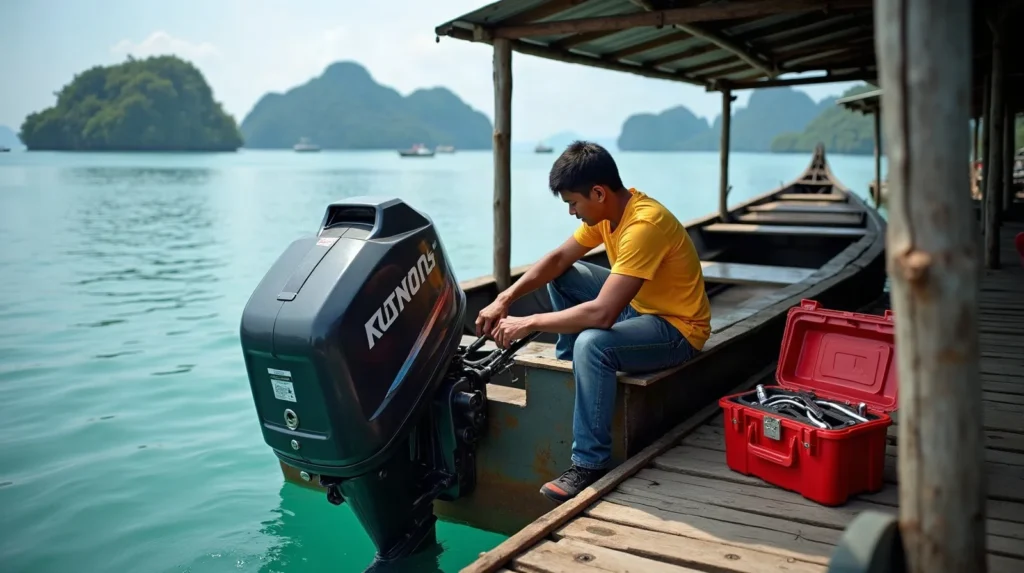
Outboard selection for remote Papua operations follows one rule before all others: choose the engine your nearest competent mechanic can actually service. In practice that means mainstream four-stroke families from the brands with genuine parts presence in Sorong and Jayapura, sized so the boat cruises at 70–80 percent throttle fully loaded, in mechanical or basic electronic control trims rather than the most computerised variants. The best engine on paper is the wrong engine if its injectors, sensors, or software tools are a two-week flight away.
Serviceability beats specification
Around Sorong, parts counters and mechanic experience concentrate heavily on a handful of engine families. Before fixing any brand in a build specification, we verify three things: filter, impeller, anode, and gear-oil stock physically on shelves in Sorong; a mechanic within reach who has opened that engine model; and realistic delivery time for a powerhead or lower unit. A boat is an income asset — every week it waits for parts is revenue gone. This check is standard in our commissioning process before an engine package is signed off.
Sizing: cruise at 70–80 percent, not at the limit
An outboard that must run wide open to hold schedule is an outboard that will fail early. Size the package so the fully loaded boat cruises at 70–80 percent throttle, leaving reserve for headwinds, adverse tide in the Dampier Strait, and the slow displacement creep every working boat suffers. On a 10 m dive tender that typically means twin engines totalling 230–300 hp; on a 7 m resort runabout, a single 115–150. The load math driving these numbers is set out in the hull weight and fuel burn article.
Four-stroke versus two-stroke, settled honestly
Modern four-strokes win on fuel burn (20–30 percent better than old carburetted two-strokes), noise, and smoke, and their reliability record in tropical commercial service is now long. Their cost is complexity: more sensors, more electronics, oil changes to schedule. Where old-style two-strokes survive in Papua it is because any village mechanic can revive them; but their fuel appetite on long runs erases that advantage for a commercial operator. Our default is mainstream four-strokes in the simplest control trim available, with the electronic diagnostics cable and software licence bought with the boat — not left behind at the dealer.
Rigging details that matter more out here
Specify dual fuel filtration — a 10-micron water-separating primary before each engine’s own filter — because fuel quality from drums and village pumps varies. Specify stainless props for reef country, plus one spare aluminium prop per engine as the get-home compromise. Mount engines with isolation against the galvanic issues covered in the corrosion protection guide. And insist on full-length rigging tubes with drip loops; chafed harnesses in a wet transom well cause a disproportionate share of remote breakdowns. The spares that back all this up are listed in our onboard spares kit article.
One engine or two?
For any boat that routinely carries guests beyond easy rescue range — which in Raja Ampat means most of them — twin engines or a documented single-engine contingency plan is part of responsible specification. The full argument, including the fuel and cost penalties of twins, gets its own treatment in the twin versus single redundancy article; the short version is that twins buy schedule reliability and rescue independence, and most of our long-range specifications carry them.
Fuel quality strategy: designing for the fuel you will actually get
Engine selection in Papua is inseparable from fuel reality. Petrol arrives by drum, by jerry can, and occasionally by informal decanting, with water and particulates as travelling companions. Beyond the dual filtration already specified, the operating answers are: settle drums upright for a day before drawing from them, draw from a floating pickup or from mid-drum rather than the bottom, keep boat tanks full overnight to limit condensation, and drain water separators every single morning as a crew ritual. Engines themselves should be specified with conventional fuel systems where the maker offers a choice — the most pressure-sensitive high-output variants are the first to protest drum fuel, and the protest happens mid-strait.
Warranty, dealers, and paperwork that follows the boat
A new outboard’s warranty is only as useful as the dealer network that honours it. Before purchase, establish in writing which dealer services Papua operations, whether warranty work can be performed by the Sorong workshop you intend to use, and what documentation of servicing the maker requires to keep cover alive. Keep the service log aboard, in the spares box, with receipts — a habit that also raises resale value materially. For twin installations, register both engines and align their service schedules so one haul-out day covers the pair. These are unglamorous details, and they are the difference between a warranty claim and a shrug when a powerhead fails in year two.
Frequently Asked Questions
Which outboard size suits a 7 m resort boat in Raja Ampat?
A single 115–150 hp four-stroke gives a loaded cruise around 20 knots with sensible reserve for a 7 m hull in transfer duty. Pair it with dual fuel filtration and a spare prop, and verify parts support in Sorong before committing.
Are high-thrust or standard gear ratios better for loaded tenders?
Heavily loaded, moderate-speed workboats often benefit from high-thrust variants with deeper gear reduction and bigger props — better hole-shot and control at low speed. Fast, lighter tenders stay with standard ratios. Decide on the propeller calculation, not the brochure.
Should I buy engine electronics diagnostic tools with the boat?
Yes. For electronically controlled outboards operated far from dealers, the diagnostic interface and software belong in the boat’s inventory, and a crew member should be trained to read fault codes. It routinely turns a satellite call into a fixed engine.
Raja Ampat Boat Builder Desk — a specialist maritime brand under Juara Holding Group. Construction contracts issued by PT Komodo Galangan Nusantara. WhatsApp +62 811-3941-4563 · bd@juaraholding.com