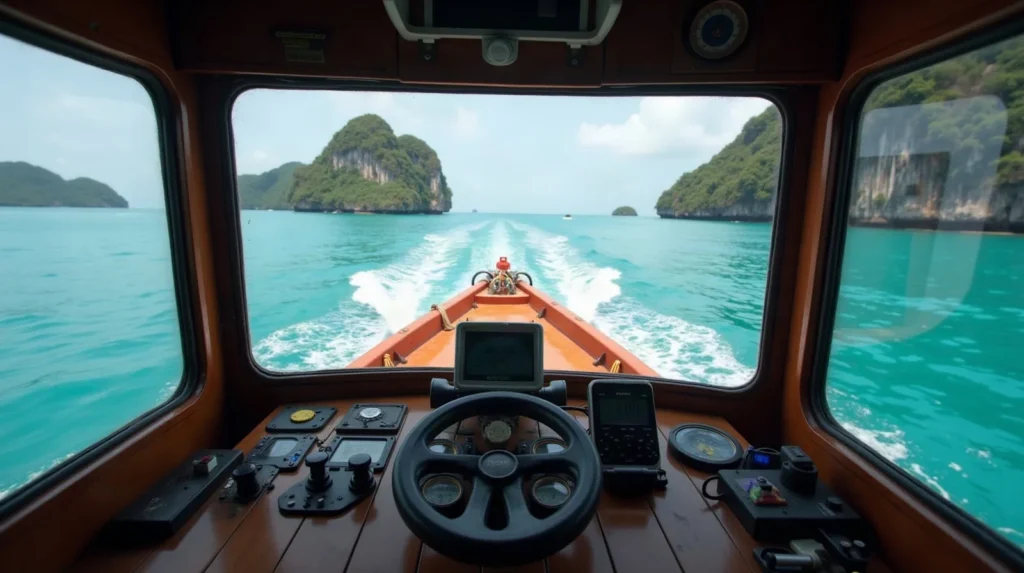
Fuel range planning between Sorong and Waisai starts from the crossing itself: roughly 35–40 nautical miles across the Dampier Strait depending on berth and route. A loaded 10 m tender burning around 2 litres per nautical mile needs about 70–80 litres each way in fair conditions — but the planning number is not the fair-weather number. Add 20–30 percent for adverse tide and chop, then a fixed 30 percent reserve on the total, and the honest round-trip fuel budget for that tender approaches 220–250 litres. Boats get into trouble on this run not because the crossing is long, but because it was fuelled for the calm morning and run home against the afternoon.
Why the strait inflates fuel burn
The Dampier Strait carries strong tidal streams, and when they oppose the wind the sea stacks short and steep. A hull that cruises at 20 knots on 2 litres per mile in the morning calm may hold only 14–16 knots in afternoon chop at higher trim and throttle — burning 25–35 percent more per mile while going slower. Current itself moves the goalposts: two knots of adverse stream on a 20-knot boat adds ten percent to every mile’s cost. The sea conditions behind these numbers are described in our Dampier Strait article; the design response — tankage and hull form — is a build decision, made at specification time.
The planning method, step by step
First, establish your boat’s real burn: run a measured mile series at operating load — not delivery weight — at your standard cruise, and log litres per nautical mile. Second, price the route honestly: distance dock to dock, plus weather margin of 20–30 percent for this strait. Third, apply the fixed reserve: 30 percent of the total stays in the tank untouched, always. Fourth, re-check the arithmetic whenever the boat gains weight — new gear, more guests, a heavier canopy — because burn follows displacement, as quantified in the hull weight and fuel article.
Fuel availability: plan around the shore, not the brochure
Sorong has reliable marine fuel supply; Waisai’s availability is generally good but subject to delivery schedules; beyond Waisai, planning assumes drums and jerry cans arranged in advance. Commercial operators running daily crossings should hold bunkering relationships on both sides and never plan a schedule that requires fuel to be available same-day at the far end. For multi-leg itineraries deeper into the islands, the calculation extends leg by leg — the method we walk through for the southern run in the Sorong–Misool fuel article.
Building the boat around the range requirement
Tankage is a design decision that outlives every schedule change. For Dampier Strait commuters we specify built-in tankage covering at least two full round trips at working burn — roughly 450–500 litres on the example tender — so one fuelling day covers two operating days and a missed bunkering never cancels a departure. Long-range specifications add crossover plumbing between tanks, sight gauges or calibrated senders the crew actually trusts, and deck arrangements for drum carriage on expedition legs. These decisions are fixed in the specification stage of the commissioning process, and they shape the boats described across our Sorong–Waisai–Misool logistics page.
Measuring real burn: the two-day protocol
The measured-mile method deserves spelling out, because most quoted burn figures in the region are folklore. Day one, calm morning: load the boat to honest working displacement, run a fixed GPS course of at least two nautical miles in both directions at each of three speeds — economical cruise, standard cruise, and fast passage — logging fuel flow or precise tank drop for each. Day two, repeat one speed in the afternoon chop to capture the weather penalty as your own number rather than a guess. Write the results on a laminated card at the helm: litres per mile at each speed, calm and rough. Every fuel decision the crew makes for the life of the boat now stands on measured ground.
Schedules, cancellations, and the fuel connection
Fuel planning and scheduling are the same discipline viewed from two sides. Operators who fuel for two days of operations, hold morning-departure discipline, and keep the reserve untouchable cancel fewer trips: they are never waiting for a delivery, never gambling on an afternoon crossing with thin margins, never improvising. Guests experience this as reliability; accountants experience it as revenue. The tankage decision made at build time is what makes the whole posture possible — which is why range planning appears in the first specification conversation for every boat we commission, not as an operational afterthought once the hull is wet. Tanks are welded in once; the schedule leans on them for twenty years.
Frequently Asked Questions
How long does the Sorong to Waisai crossing take by speedboat?
At a loaded cruise of 18–22 knots, roughly two hours dock to dock in fair conditions; afternoon chop can stretch it toward three. Public ferries take around two hours on their own schedule.
What fuel reserve should a commercial boat carry on this run?
Thirty percent of the total planned burn, treated as untouchable. If arrival would dip into the reserve, the correct responses are slowing to a more efficient speed, shortening the route, or not departing — never quietly spending the margin.
Is it safe to carry jerry cans of petrol on a guest boat?
It requires designed stowage: ventilated deck racks away from guests, ignition sources, and sun, with proper securing. Ad-hoc cans loose in a transom well are a fire and stability hazard. If drum or can carriage is routine, build dedicated stowage into the specification.
Raja Ampat Boat Builder Desk — a specialist maritime brand under Juara Holding Group. Construction contracts issued by PT Komodo Galangan Nusantara. WhatsApp +62 811-3941-4563 · bd@juaraholding.com