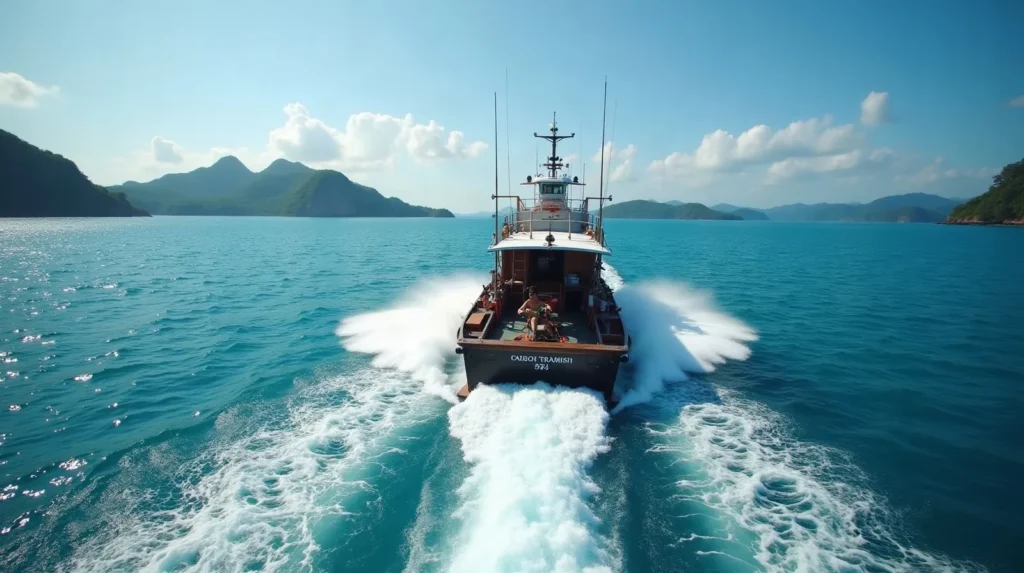
On a planing tender, hull weight converts to fuel burn almost linearly: as a working rule, every 10 percent of extra displacement costs roughly 8–12 percent more fuel to hold the same cruising speed. For long-range West Papua runs — Sorong to Misool and back is a serious fuel commitment — the weight you build into the boat, and the weight you load onto it, are the two biggest fuel decisions you will ever make. Engine brand and propeller tuning matter, but they adjust the margins; displacement sets the bill.
The physics, briefly and honestly
A planing hull at cruise supports its weight on dynamic lift. More weight means more lift required, which means more wetted surface, more trim drag, and more thrust to hold plane — hence the near-linear fuel relationship. Below planing speed the penalty is gentler, which is why heavily loaded boats sometimes save fuel by slowing right down to displacement speed; but for a working tender whose value is schedule, the practical answer is managing weight, not surrendering speed. The deadrise choices that interact with this are covered in our deadrise article.
Where build weight hides
Structural weight is visible in the specification; the creep is elsewhere. Cabin structures add hundreds of kilograms high in the boat. Oversized consoles, teak-look decking, double-bottomed fish boxes, a second helm station, generous wiring looms with no weight budget — each is small, together they can push a 10 m tender 15 percent over its design displacement before the first passenger boards. During build supervision we weigh against a budget at defined stages, because yards under commercial pressure will rarely volunteer that the boat is getting heavy. That discipline is part of the commissioning process we run for every hull delivered north.
Where operating weight hides
Fuel itself is the biggest movable mass on a long-range tender: 800 litres is roughly 600 kg. Water, dive cylinders, spares, and the slow accumulation of gear that never leaves the boat all stack on top. Two operating habits pay for themselves: fuel to the leg plus reserve rather than brimming every tank every day — the calculation method in our Sorong–Misool fuel burn article — and a quarterly strip-out of accumulated clutter. On a boat running 5,000 nautical miles a season, 300 kg of habitual overload is a real USD figure in fuel by December.
Material choice and the weight ledger
Aluminium structure typically comes out lighter than an equivalent solid-laminate FRP hull built to remote-area robustness, and dramatically lighter than traditional timber. That saving compounds: a lighter hull needs less power, which means lighter engines and less fuel carried for the same range, which means lighter still. It is one of the quieter reasons aluminium dominates our long-range specifications, alongside the reef-contact case made in the hull material guide and the comparison on the aluminium versus fiberglass page.
Specifying for range: the numbers that matter
For a long-range tender brief, fix these before styling: maximum operating displacement (everything aboard, honestly counted), target cruise speed at that displacement, fuel burn per nautical mile at that speed from comparable hulls, and tankage for the longest leg plus 30 percent. Then hold the build to the displacement number. A boat delivered under its weight budget is the only kind that ever beats its range prediction in service.
Weighing the boat: the habit that keeps numbers honest
Displacement drift is invisible without measurement, so build measurement into the boat’s life. At the yard, insist on witnessed weighings at structure completion and at launch, against the designer’s weight budget. In service, the practical proxy is the boot-top: photograph the loaded waterline against the painted line each season, in the same trim and fuel state. Two centimetres of extra immersion on a 10 m hull is roughly several hundred kilograms of accumulated weight — gear, spares, water in foams, paint layers — and it is fuel being burned on every mile. Fleets that weigh annually and strip out clutter run measurably better numbers than their sisters, on identical hulls.
Propellers: the least expensive range extension available
Once weight is controlled, propeller selection converts the remaining potential into miles. A prop pitched for the boat’s real operating displacement — not its brochure weight — lets the engines reach their rated revolutions at full throttle, which is where both performance and engine longevity live. Over-pitched props lugging under load are endemic on working boats in the region, wasting fuel and cooking engines. On long-range tenders we trial at least two propeller options during the delivery trials, loaded, and record the litres-per-mile difference; a correct prop choice routinely improves range five to eight percent, which on the Misool run is the reserve margin itself.
Frequently Asked Questions
How much fuel does a loaded 10 m tender burn per nautical mile?
With twin mid-range outboards at 18–22 knots, typical working figures run 1.6–2.4 litres per nautical mile depending on displacement, hull form, and sea state. Treat any single quoted figure with suspicion until it states the load and speed behind it.
Is it worth paying more in USD for a lighter build?
Usually, if the boat runs real miles. A build that saves 400 kg on a high-utilisation tender repays its premium in fuel and engine wear within a few seasons, and rides higher and drier for its whole life.
Does adding a second engine hurt fuel economy?
Twin installations weigh more and add drag, costing several percent at cruise against a single of equal total power. Most remote-area operators accept that cost for redundancy; the trade is examined in our twin versus single outboard article.
Raja Ampat Boat Builder Desk — a specialist maritime brand under Juara Holding Group. Construction contracts issued by PT Komodo Galangan Nusantara. WhatsApp +62 811-3941-4563 · bd@juaraholding.com