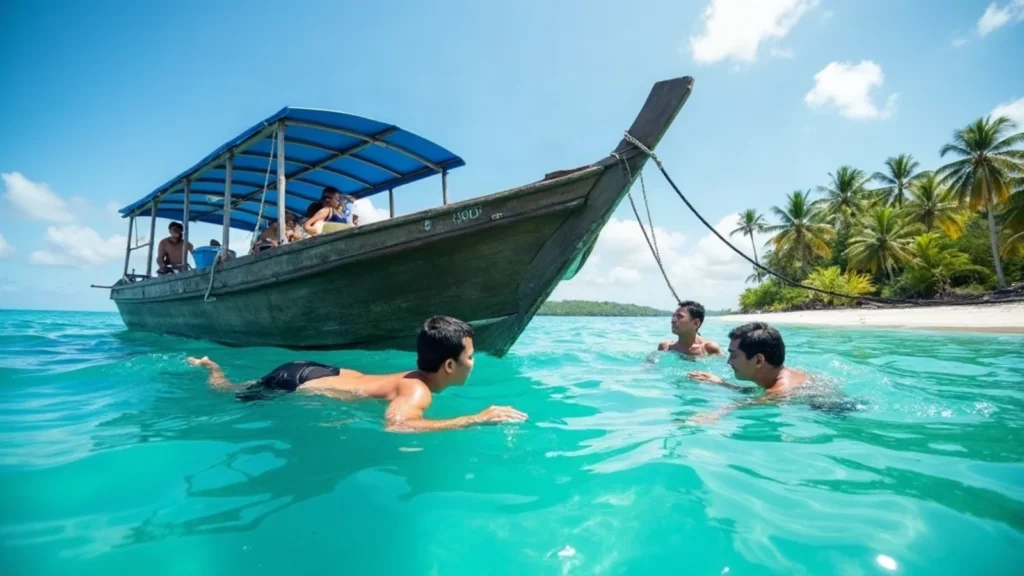
A homestay snorkel boat succeeds or fails on four things: shade, boarding, dry stowage and simplicity. Guests spend far more time sitting aboard than in the water, the Dampier Strait runs current that catches out badly designed boarding arrangements, and the boat has to be repairable by whoever is on the island. Everything else is secondary. Indicative budgets are USD 25,000–150,000 for 8–13 m craft.
Size to the guests you actually carry
Most homestays run six to twelve guests on a snorkel day. Building for twenty because a big group might appear once a season is a common and expensive error: fuel and crew scale with the hull, bookings do not. An 8–10 m boat that is full four days a week returns more than a 13 m boat that is half full six days a week.
Where a homestay genuinely needs to move larger groups occasionally, chartering a neighbour’s boat for those days is almost always the better economics than owning capacity that idles.
Shade: the detail guests remember
Shade is the most under-designed element on Raja Ampat day boats. Three rules:
- Shade people, not deck. A canopy must cover seated guests at the sun angles you actually run — 08:00 and 15:00, not just noon.
- Extend it aft. The area where guests de-kit and dry off after snorkelling is where sun exposure hurts most.
- Allow airflow. A low, enclosed canopy in still air becomes an oven. Height and open sides matter as much as coverage.
A boat with genuinely good shade gets better reviews than a faster boat with poor shade. It is the lowest-cost quality signal available.
Boarding in current and at the beach
Most homestay boats must load at a beach and recover snorkellers in open water — two different problems.
Beach loading needs shallow draft, a bow or side arrangement guests can use without climbing, and a hull that tolerates touching sand. Protected or tilting propulsion matters here (see shallow draft designs).
Water recovery needs a ladder that is wide, deeply immersed and angled rather than vertical, with a handhold above it. Snorkellers in fins and with limited swimming strength are the hardest people to get out of the water, and the Dampier Strait’s current makes it harder. A ladder that works for a fit diver in flat water is not sufficient.
Deck layout
| Zone | Requirement |
|---|---|
| Seating | Bench with backrest, draining cushions, enough width for adults in life jackets |
| Dry stowage | Sealed lockers for bags, phones and cameras — not a tarpaulin |
| Wet zone | Aft area near the ladder for fins, masks and wet towels, with drainage |
| Boarding path | Clear route from seating to ladder without stepping over people or gear |
| Crew station | Helm with genuine all-round visibility for reef navigation |
| Refreshments | Secure cool box position that does not block circulation |
Keep the systems simple
Every added system is a failure point hours from the nearest workshop. On a homestay boat that means: one outboard brand with regional parts support, simple wiring with accessible fuses, visible fuel filters with water separators, a manual bilge pump backing up the electric one, and no proprietary electronics that cannot be diagnosed locally.
Owners are often tempted by chart plotters and sound systems. Spend that money on shade, seating and a second bilge pump instead — those keep the boat earning.
Safety that matches the operation
- Life jackets sized for adults and children, stowed accessibly rather than buried.
- A working VHF, since mobile coverage fails across much of the strait.
- Basic first aid and, where guests swim in current, a throwable float and line.
- A briefing routine and a headcount discipline — the strongest safety measures on a snorkel boat are procedural.
- Anchoring gear suited to reef-safe practice, so the boat is not damaging what guests came to see.
Indicative budgets
| Boat | Configuration | Indicative USD |
|---|---|---|
| 8–10 m homestay snorkel boat | Single outboard, 8–12 guests, full canopy | 25,000 – 60,000 |
| 11–13 m day trip boat | Twin outboards, 16–24 guests, shaded deck, small head | 70,000 – 150,000 |
Turnkey planning figures excluding owner-supplied electronics and delivery. Detail: homestay and workboat new-builds and Waisai and Dampier Strait builds.
Adding light dive capability
Many homestays eventually add guided dives. Building in the possibility from the start costs little: allow deck space and structure for a small tank rack, plan a rinse tub position, and specify a ladder that works for divers in full kit. Retrofitting these is always more awkward than designing them in. See dive deck design.
To design a day boat around your actual guest numbers and routes, contact +62 811 3941 4563 or bd@juaraholding.com.
Frequently Asked Questions
What is the best layout for snorkel day boats serving homestays in the Dampier Strait?
Bench seating with backrests and draining cushions under shade that covers guests at real sun angles, sealed dry lockers for bags and cameras, a drained wet zone aft near the ladder, a clear boarding path that does not cross seated guests, and a helm with genuine all-round visibility for reef navigation.
What size boat should a Raja Ampat homestay build?
Usually 8 to 10 m for six to twelve guests. Fuel and crew costs scale with the hull rather than with bookings, so a smaller boat running full four days a week returns more than a larger one running half full six days a week. Charter a neighbour’s boat for occasional large groups.
What makes a good boarding ladder for snorkellers?
Wide, deeply immersed and angled rather than vertical, with a handhold above it. Snorkellers in fins with limited swimming strength are the hardest guests to recover, and Dampier Strait current makes it harder, so a ladder adequate for a fit diver in flat water is not sufficient.
Which equipment is worth spending on for a homestay boat?
Shade, seating, dry stowage, a second bilge pump and an outboard brand with regional parts support. Chart plotters and entertainment systems rarely earn their cost on this type of boat, and every extra system is a potential failure hours from the nearest workshop.