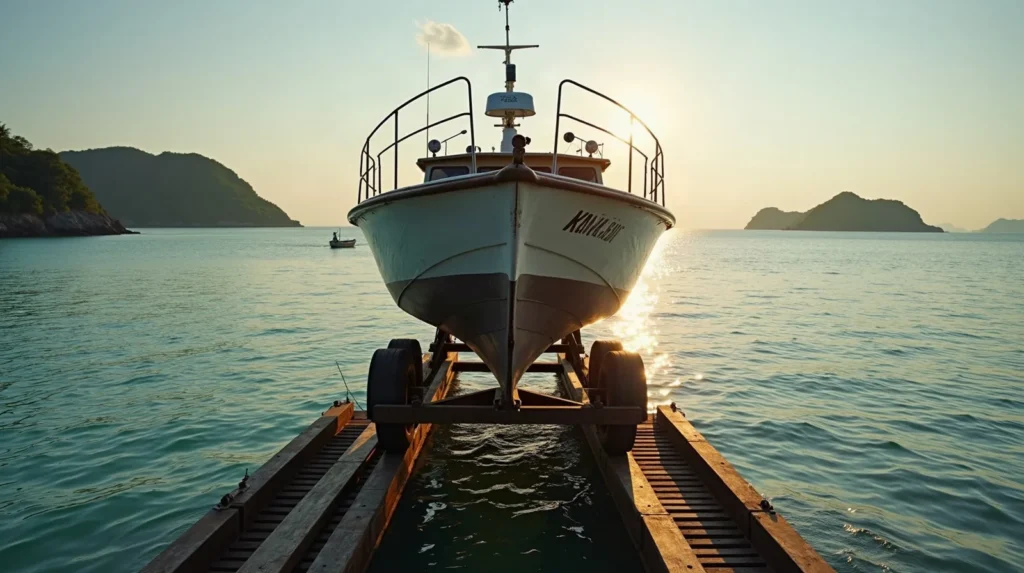
Deadrise — the angle of the hull bottom measured from horizontal — is the single number that most directly trades ride comfort against shallow draft. More deadrise (20–24 degrees at the transom) slices through chop and softens slamming but needs deeper water and more power; less deadrise (8–14 degrees) floats shallow, planes early, and burns less fuel, but pounds in waves. For Raja Ampat operations the working compromise is a variable-deadrise hull: a fine 40–50 degree entry forward that flattens to 12–16 degrees at the transom, giving a boat that crosses the Dampier Strait without punishment yet still noses into a lagoon shore.
What deadrise does in waves
When a planing hull meets a wave, the deadrise angle determines whether the bottom lands like an axe or a paddle. Deep-V sections part the water and spread the impact over time; flat sections stop dead against it. In the short, steep wind-against-tide chop typical between Sorong and Waisai — the conditions detailed in our Dampier Strait article — the difference between a 12-degree and a 20-degree transom deadrise is the difference between guests arriving fresh or arriving rattled. Slamming also loads the structure: repeated pounding fatigues welds and laminates and shakes fittings loose over seasons.
What deadrise costs in draft and fuel
Every degree of deadrise pushes the hull deeper for the same displacement. A flat-bottomed 10 m workboat may float in 40 cm; a constant deep-V of the same length can need 70–80 cm before the props are considered. In Raja Ampat that difference decides which lagoon passes, beach landings, and jetty approaches are routine versus off-limits — the operational geography we map in the reef operations hull guide. Deep-V hulls also demand more power to plane and hold plane, which shows up directly in fuel burn on long runs; the weight-and-fuel relationship is quantified in our hull weight versus fuel burn article.
Variable deadrise: how designers split the difference
Modern working hulls are not one angle. The entry — the first third of the waterline — carries steep deadrise to cut chop; sections aft flatten progressively so the boat rides on an efficient, shallow surface once on plane. Spray chines and lifting strakes recover dryness and lift that the flattened aft sections give up. For the 8–12 m tenders we commission, a transom deadrise of 12–16 degrees with a fine entry has proven the honest Raja Ampat compromise: shallow enough for careful beach work, soft enough for daily crossings.
Matching deadrise to your actual routes
Pull your route list and split it: protected lagoon and inshore work versus open crossings. An operation living inside the Waigeo lagoons can take 10–12 degrees and enjoy the draft and fuel savings. An operation running Misool supply legs or daily strait crossings should hold out for 16 degrees or more at the transom with a serious entry forward. When we draw a specification through the custom dive tender service, the route audit fixes this number before any styling conversation happens — the sequence the commissioning guide insists on.
Reading deadrise on a drawing — and on a real boat
Owners reviewing proposals should know where to look. On a lines drawing, transom deadrise is stated as a single angle; ask also for the angle at midships and the entry half-angle forward, because the transom number alone hides how the hull actually meets a wave. On an existing boat, sight the hull from dead astern on the hard: a constant-V shows the same angle all the way forward, a variable-deadrise hull visibly twists flatter toward the stern. Ask builders for the running trim at cruise too — a hull that needs heavy tab correction to stay level is telling you its sections and its weight distribution disagree, and no deadrise number rescues that.
Deadrise, stability, and the loaded dive deck
There is a stability cost to deep sections that dive operators feel directly: deeper V means a rounder-bilged, tender-feeling boat at rest, exactly when twelve divers stand up together to kit up. Flatter aft sections give form stability — the reassuring stiffness underfoot that guests read as safety. This is another reason the variable-deadrise compromise dominates working tenders: fine forward for the crossing, flat and stable aft for the fifteen minutes of choreography before every dive. When comparing proposals, ask for the loaded roll behaviour at rest, not just the ride claims under way; both halves of the day matter. A sea trial that includes ten minutes at anchor with the whole party standing on one side tells you more about the working boat than any brochure figure, and a designer confident in the sections will welcome the test rather than talk around it.
Frequently Asked Questions
What deadrise angle is best for a Raja Ampat dive tender?
A variable-deadrise hull with roughly 12–16 degrees at the transom and a fine entry forward suits most operations: comfortable in strait chop, workable in shallow anchorages, efficient at cruise. Constant deep-V hulls above 20 degrees are rarely justified here.
Does higher deadrise always mean a drier ride?
No. Dryness comes mainly from chines, flare, and freeboard, not the bottom angle alone. A well-chined moderate-deadrise hull is often drier than a deep-V with poor spray control.
How does deadrise interact with beach landings?
Flatter aft sections let the boat sit upright and stable when it takes the ground; deep-V hulls heel awkwardly and concentrate load on the keel line. If beach landings are routine, keep transom deadrise moderate and add a protected keel shoe as described in our keel protection article.
Raja Ampat Boat Builder Desk — a specialist maritime brand under Juara Holding Group. Construction contracts issued by PT Komodo Galangan Nusantara. WhatsApp +62 811-3941-4563 · bd@juaraholding.com