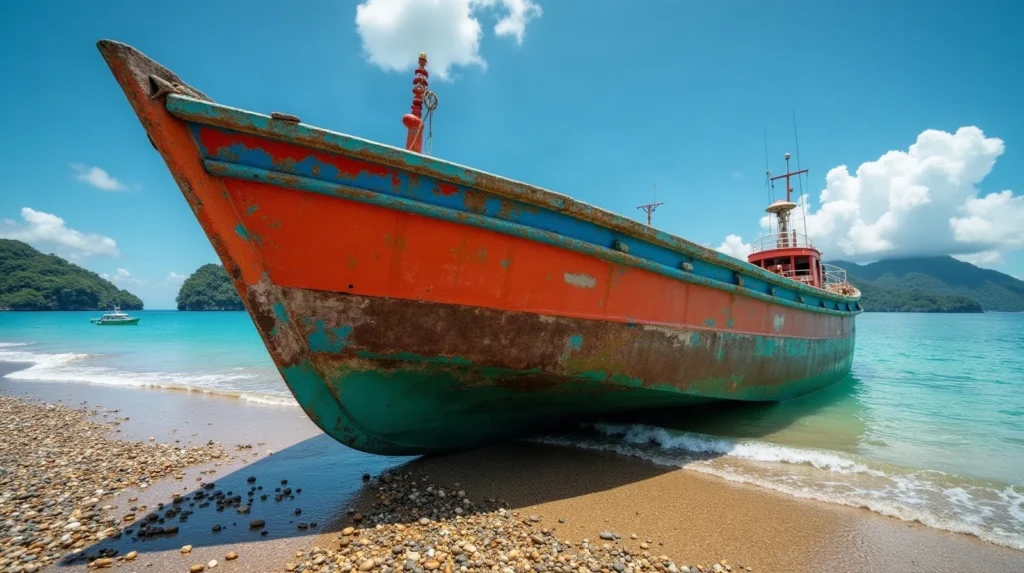
A sacrificial keel is a replaceable wear strip — typically a bolted or welded shoe of thicker aluminium, HDPE, or hardwood — fitted along the hull’s centreline so that coral groundings, beach landings, and jetty contact consume the shoe instead of the hull. For reef boats in Raja Ampat, where touching bottom occasionally is an operational reality rather than an accident, a properly specified keel shoe converts hull damage from a structural repair into a maintenance line item. It is one of the least expensive protections you can specify on a new build and one of the costliest to wish you had later.
Why reef boats need designed-in grounding protection
The honest operating pattern in this region includes deliberate soft groundings: nosing onto homestay beaches, easing over lagoon sills at mid-tide, holding position against a coral shelf while guests board. Each contact is minor; the accumulation is not. Without protection, aluminium hulls collect keel-line dents and abrasion that eventually thin the plate, while fiberglass hulls chip gelcoat and expose laminate to water ingress — the damage modes compared in our reef hull material article. A keel shoe accepts that contact will happen and gives it somewhere harmless to go.
Shoe materials: aluminium bar, HDPE, hardwood
On aluminium hulls the standard is a thick extruded bar or half-round — 12–25 mm proud of the plating — welded or bolted along the keel and lower stem. Welded bar is strongest; bolted bar is easier to replace and is what we usually specify for boats that beach daily. HDPE (high-density polyethylene) shoes bolted over the keel line slide beautifully on sand and rubble, protect against abrasion, and replace with hand tools, though they need generous fastening to resist peeling on rock. On timber hulls, a traditional hardwood false keel with a metal band remains effective and locally repairable. On FRP hulls, specify a solid-laminate keel band with a bolted metal or HDPE shoe — never rely on gelcoat.
Design details that separate good shoes from decoration
A shoe must extend from the forefoot — where beach contact begins — past the midpoint of the run, and on shallow-draft workboats to the transom. It must stand proud enough that the hull plating never touches first, including when the boat settles heeled. Fastenings on aluminium must be isolated to prevent the galvanic cells described in our corrosion protection guide. And the shoe must be drawn on the lines plan, because it adds drag if slapped on as an afterthought; a properly faired shoe costs under one knot, an unfaired one considerably more.
Protecting what the shoe cannot reach
Keel protection does not cover propellers and skegs — the most expensive victims of a hard grounding. Outboard-powered reef boats should specify skeg guards and, where operations are rough, stainless prop guards accepting a small efficiency penalty. Waterjet and surface-drive options remove the exposed propeller entirely and appear in some of our workboat specifications for extreme shallow-water duty. Transducers and intakes belong in recessed or protected positions, decided at the design stage of the commissioning process.
Maintenance: the replacement rhythm
Inspect the shoe at every bottom cleaning and log wear. HDPE shoes on daily-beaching boats typically replace every one to three years; aluminium bars last longer but should be re-faired when gouged. The point of the system is that this replacement is planned, budgeted in USD as consumable maintenance, and done without touching hull structure. A shoe worn through and ignored is just a hull with extra steps — put it on the same inspection sheet as anodes and outboard mounts.
Fitting shoes across the fleet, not just the flagship
Operators running mixed fleets — a good tender, an older workboat, a borrowed longboat in peak season — get the best return by standardising keel protection across all of them. The materials are inexpensive, the fitting is a haul-out job measured in days, and the payoff is that the least glamorous boat in the fleet stops generating the most hull repairs. Standardising also simplifies stock: one HDPE section profile, one fastener specification, one spare length in the container. We specify shoe details as a fleet standard document for multi-boat owners, so every future build and refit inherits the same protection without redesign.
What grounding damage costs when it is not prevented
The economics deserve stating plainly. A worn HDPE shoe replaced on schedule is a few hundred US dollars in material and yard time. An unprotected aluminium keel line thinned by seasons of abrasion means plate replacement — cutting, welding, and repainting measured in thousands, plus the haul-out and the lost operating weeks. On fiberglass, a keel worn through gelcoat into laminate invites water into the structure, and the repair grows with every month it waits. Set against those numbers, the keel shoe is not an option on the specification sheet; it is the line that protects the largest single item on it.
Frequently Asked Questions
Does a sacrificial keel slow the boat down?
A faired shoe designed into the lines costs a fraction of a knot at cruise — usually unmeasurable in operation. An unfaired retrofit bar can cost noticeably more, which is why the shoe belongs in the original design.
Can I add a keel shoe to an existing boat?
Yes; bolted HDPE or bar shoes retrofit well if the keel line is straight and sound. On aluminium, retrofit fastenings must be properly isolated. Expect better results and lower cost when the shoe is specified at build time.
What should I do after a hard grounding even with a shoe fitted?
Inspect immediately: check the shoe fastenings, sight along the keel for deflection, and inspect frames or floors above the impact zone from inside. The shoe absorbs abrasion and moderate impact; a hard stop at speed still warrants a structural look before the next loaded run.
Raja Ampat Boat Builder Desk — a specialist maritime brand under Juara Holding Group. Construction contracts issued by PT Komodo Galangan Nusantara. WhatsApp +62 811-3941-4563 · bd@juaraholding.com