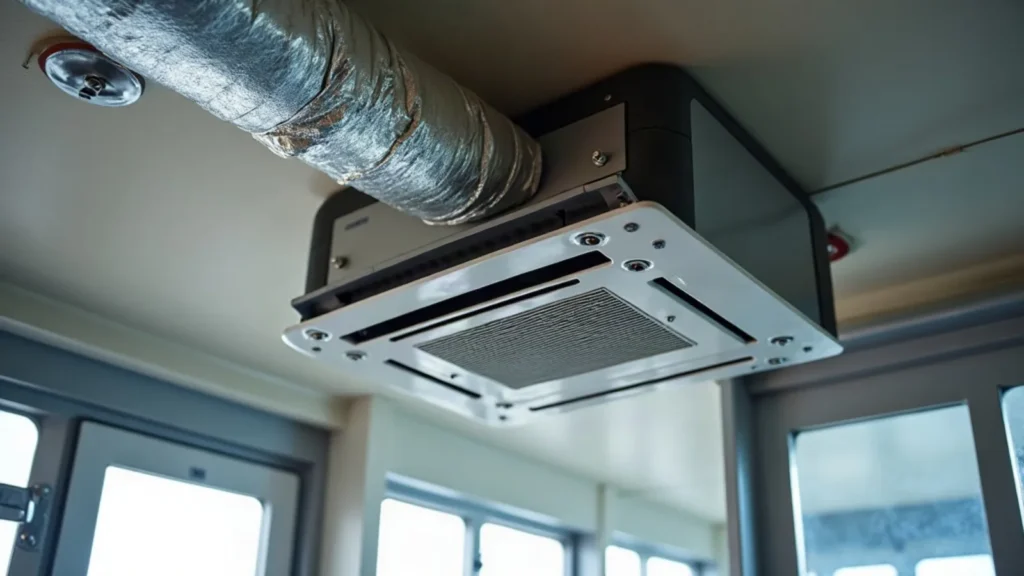
Air conditioning is the largest continuous electrical load on a Raja Ampat liveaboard, and the most common source of guest complaints — either because cabins are too warm or because the plant is too loud to sleep through. Both problems are designed in, not caused by the equipment. The fix is a heat load calculation, a serious insulation budget and duct design that treats noise as a specification item.
Why the tropics change the arithmetic
Raja Ampat runs air temperatures above 30°C, seawater near 29–30°C and humidity that rarely drops. That combination affects marine air conditioning in three ways. Seawater-cooled condensers reject heat less effectively into warm water, so nominal capacity is not delivered capacity. Dehumidification consumes a large share of the cooling load — much of the work is removing moisture, not lowering temperature. And there is no night-time recovery: a cabin that gains heat all day does not cool down after sunset without the plant running.
Specifications copied from temperate or Mediterranean practice under-deliver here, consistently.
Every sound build starts on paper — designing for long-range island work sets the lines, stability and structure the yard then follows.
Start with a heat load calculation
The correct method is a per-space calculation, not a rule of thumb per cabin. Inputs:
- Solar gain through deckheads, hull sides and glazing, by orientation and time of day.
- Conducted gain from adjacent unconditioned spaces — engine room, galley, laundry.
- Internal gains from occupants, lighting and equipment.
- Fresh air load, which in humid conditions is dominated by moisture removal.
The output is a required capacity per space and a total that feeds the electrical load table for generator sizing — see sizing fuel, water and generators.
Insulation: the decision that pays every night
Under-insulating lowers the build price and raises fuel cost for the life of the vessel. It is the clearest example of a false economy in liveaboard specification. Priorities, in order of return:
- Deckheads under exposed decks. The largest solar gain path on any vessel. Insulate generously and, where possible, shade the deck above.
- Bulkheads adjoining engine room, galley and laundry. These carry both heat and noise.
- Hull sides above the waterline in cabin spaces.
- Glazing. Area, orientation, tinting and external shading. A large unshaded window facing the afternoon sun can dominate a cabin’s entire load.
Timber construction offers a genuine advantage here — see wood vs aluminium vs fiberglass. An aluminium vessel needs a substantially larger insulation package to reach the same comfort, and that cost belongs in the material comparison.
System architecture
| Approach | Strengths | Trade-offs |
|---|---|---|
| Self-contained units per cabin | Simple, independent, easy to replace, failure affects one cabin | Noise inside the cabin; more condensers; more through-hull fittings |
| Chilled water central plant | Quiet in cabins, efficient at scale, single machinery space | Higher cost and complexity; central failure affects the whole vessel unless redundant |
| Split direct expansion | Compressors remote from cabins, moderate cost | Refrigerant runs need careful routing and competent servicing |
For vessels above roughly eight cabins, chilled water with redundancy usually wins on comfort and long-term efficiency. Below that, well-installed splits are frequently the pragmatic answer — particularly where local servicing capability is a consideration.
Noise is a specification item
Guests sleeping aboard for twelve nights notice everything. Three sources dominate: the compressor or chiller, the air handler fan in the cabin, and airflow noise at the diffuser. All three are controllable at design stage:
- Mount machinery on isolators, in a space separated from accommodation.
- Size ducts for low air velocity — most cabin airflow noise comes from undersized ducting.
- Use acoustically lined duct runs and avoid sharp transitions.
- Specify diffusers that distribute air without a draught directly onto a bunk.
Aim for a stated noise target in the cabin specification. If it is not written down, it will not be delivered.
Ventilation and condensation
Air conditioning is not a substitute for ventilation. Vessels need fresh air changes in accommodation, dedicated extraction from heads, galley and laundry, and — critically in a wooden hull — ventilation of structural voids and bilges. Poorly ventilated timber structure in a humid climate is exactly the condition that shortens a hull’s life.
Condensate management deserves attention: drains that actually clear, insulated chilled-water piping, and no cold ducts running through unconditioned voids where they will sweat into joinery.
Sensible targets
Design for a comfortable cabin at night with the plant running quietly, and accept that daytime saloon cooling in equatorial sun will always be the harder problem. Shade the boat first — awnings, overhangs and deck shading reduce load before any refrigeration is switched on — then let solar and batteries carry part of the night-time hotel demand (solar and battery options).
Framework: technical specifications. Vessel context: liveaboard new-builds. Questions: +62 811 3941 4563 or bd@juaraholding.com.
Frequently Asked Questions
How should air conditioning be designed for hot humid Raja Ampat conditions?
From a per-space heat load calculation covering solar gain through deckheads and glazing, conducted gain from engine room and galley, internal gains and the fresh air moisture load. Rules of thumb per cabin under-deliver in equatorial conditions because warm seawater reduces condenser performance and dehumidification consumes much of the capacity.
Which insulation gives the best return on a liveaboard?
Deckheads under exposed decks first, because that is the largest solar gain path. Then bulkheads adjoining engine room, galley and laundry, then hull sides above the waterline in cabins, then glazing area, orientation and external shading.
How do you stop air conditioning noise waking guests?
Mount machinery on isolators in a space separated from accommodation, size ducts for low air velocity because most cabin noise comes from undersized ducting, use acoustically lined runs without sharp transitions, and choose diffusers that avoid a draught onto the bunk. Write a cabin noise target into the specification.
Is central chilled water better than individual cabin units?
Above roughly eight cabins, chilled water with redundancy usually wins on comfort and efficiency because compressors sit away from accommodation. Below that, well-installed split systems are often the pragmatic choice, particularly where local servicing capability matters.