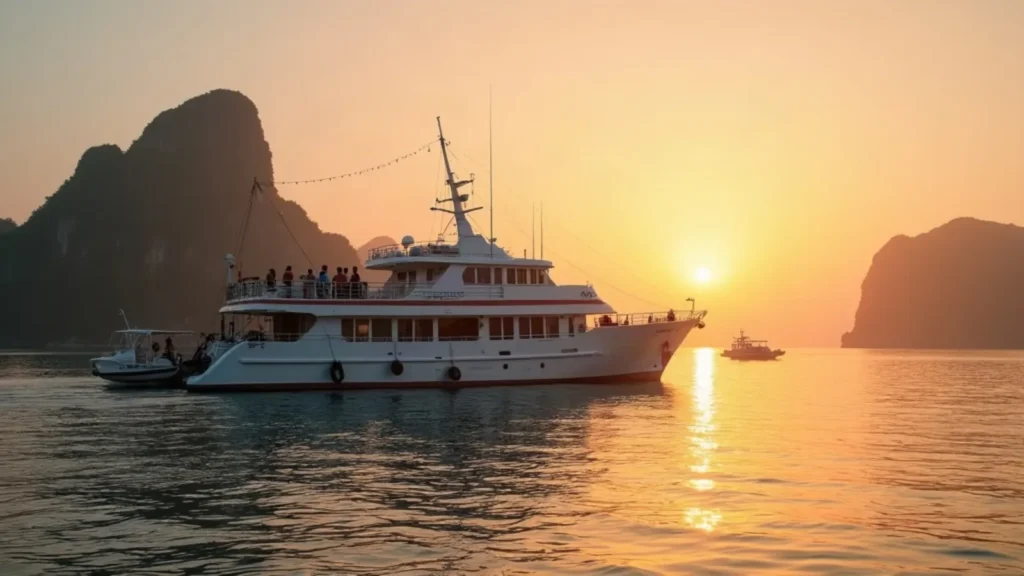
The return on a Raja Ampat liveaboard is decided by five variables — build cost, day rate, occupancy, season length and operating cost — and occupancy is where almost every business plan goes wrong. Payback on a well-run vessel is measured in years, not months. This article shows how to build the model and, more usefully, how to stress it.
The model in its simplest form
Annual gross revenue equals day rate per guest, multiplied by berths sold, multiplied by operating days. Subtract operating cost to get contribution; divide the build cost by annual contribution to get a crude payback period. Everything else is refinement.
The refinement that matters most is honesty about the middle term. Anyone can build a model that pays back in four years by assuming 85% occupancy from year one. Real vessels build a reputation over two or three seasons, and the early years carry marketing spend, crew turnover and teething costs.
Variable 1 — Build cost
Indicative USD ranges are 900,000 to 2,400,000 for a 25–32 m wooden expedition liveaboard and 2,400,000 to 6,000,000 for a larger steel or composite vessel. But the number that goes in the model is the project cost, not the build price: add delivery and commissioning, first-season spares, crew recruitment and training, launch marketing and working capital. Owners routinely under-provision this by a significant margin. Detail: pricing and investment.
Variable 2 — Day rate
Day rate is set by the market segment you can credibly serve, which is a function of the vessel, the crew and the itinerary — in that order of what you control at build stage. Specification decisions that genuinely move rate: cabin size and ensuite quality, dive deck and camera facilities, air conditioning and noise performance, and the itineraries the vessel’s range allows. Specification decisions that rarely move rate: styling details and equipment guests never see.
Design for the segment you intend to sell to. A vessel built to a mid-market specification cannot be repositioned upward later; a vessel over-specified for its market carries capital cost it cannot recover.
Variable 3 — Occupancy (the one that decides everything)
Occupancy is the highest-sensitivity variable in the model and the one most often assumed rather than researched. Model three scenarios:
| Scenario | Assumption | Use it for |
|---|---|---|
| Conservative | Modest occupancy, short season, some charters at reduced rate | Financing decisions and the question “can we survive this?” |
| Base | Realistic ramp across the first three seasons | Planning crew, marketing and cash flow |
| Optimistic | Strong occupancy after reputation is established | Understanding upside, never for the borrowing decision |
If the conservative scenario does not survive, the project is not financeable regardless of how attractive the optimistic case looks. Cabin count interacts directly here — see planning cabin count and layout.
Variable 4 — Season length
Raja Ampat has a defined main season, and vessels that cannot work outside it carry twelve months of fixed cost against fewer operating months. Two responses exist at design stage: build a vessel with the range and sea-keeping to reposition to other Indonesian cruising grounds in the off-season, or accept a shorter season and size the capital accordingly. Both are legitimate; drifting into the second by accident is not.
Variable 5 — Operating cost
The major lines on a Raja Ampat liveaboard:
- Crew — usually the largest single line, and the one where saving money costs the most revenue.
- Fuel — heavily influenced by design decisions on hull, cruise speed and generator hours (tankage and generators).
- Provisioning and logistics — remote resupply carries a premium.
- Maintenance and dry-docking — provision annually from year one.
- Insurance, permits and agency fees.
- Sales commission and marketing — frequently underestimated by owners who assume direct bookings.
Several of these are set at design stage. Insulation quality determines air conditioning load, which determines generator hours, which determines fuel spend for twenty years. That is why specification decisions belong in the investment model, not just the build budget.
Stress-test before you commit
Run the model with each of these applied singly, then in combination:
- Occupancy 15 percentage points below base.
- Delivery three months late, missing the first season opening.
- Fuel cost up materially.
- One month of unplanned downtime in high season.
- Day rate held flat for three years against rising costs.
A project that survives the first four is soundly structured. A project that only works in the optimistic case is a bet, and it should be described as one to anyone being asked to fund it.
Where design improves the return
The highest-return specification decisions are unglamorous: insulation, generator sizing, a hull operated at its economical cruise, systems that can be serviced locally, and a dive deck that lets crew turn the boat around quickly. Each protects operating days or reduces cost every single season. Financing structures are covered in financing options and partnerships; the build side in liveaboard new-builds.
To model a specific project, send vessel size, target segment and budget in USD to +62 811 3941 4563 or bd@juaraholding.com.
Frequently Asked Questions
What investment return can I expect from a Raja Ampat liveaboard new-build?
Return depends on build cost, achievable day rate, occupancy, season length and operating expenses, in roughly that order of sensitivity. Payback is normally measured in several years. The useful exercise is modelling conservative, base and optimistic occupancy scenarios rather than quoting a single headline figure.
How long does it take to recover the investment in a Raja Ampat liveaboard?
Multiple years for a well-run vessel, and the figure is highly sensitive to occupancy and day rate. Early seasons typically carry marketing spend, crew turnover and teething costs while reputation builds, so models that assume high occupancy from year one are unreliable.
Which design decisions most improve the financial return?
Insulation quality, generator sizing, operating the hull at its economical cruise band, choosing systems serviceable locally, and a dive deck that allows fast turnaround. Each of these protects operating days or reduces cost every season for the life of the vessel.
What should a liveaboard business plan be stress-tested against?
Occupancy fifteen points below base, delivery three months late missing a season opening, materially higher fuel cost, one month of unplanned high-season downtime, and day rate held flat for three years against rising costs.