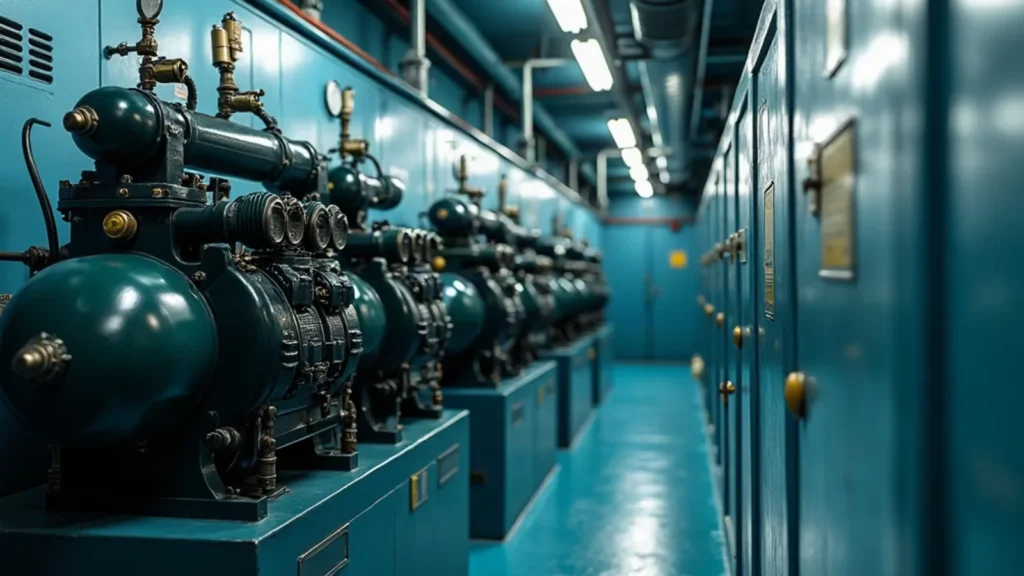
Raja Ampat’s remoteness is the design driver for every dive-safety system on a new-build. Evacuation from Misool or Wayag is measured in many hours, and the nearest recompression facility is a serious journey away. That single fact should shape oxygen capacity, communications, casualty space and compressor redundancy far more than any equipment catalogue does.
Compressor room fundamentals
The compressor installation determines operating tempo, guest comfort and — through intake placement — air quality. Five requirements apply to every build:
- Dedicated, ventilated space. Compressors belong in their own compartment, not shared with the engine room or tucked under a guest bench.
- Intake placement away from all exhausts. Main engine, generator and galley exhausts must be positioned so that no wind condition can draw them into the intake. This is a safety item, not a convenience.
- Redundancy. A single compressor is a single point of failure that cancels an afternoon or a day. Two smaller units usually beat one large one.
- Maintenance access. Filters, separators, belts and valves reachable without dismantling structure, because awkward servicing gets skipped.
- Noise and vibration control. Isolated mounts, lined bulkheads, and enough separation that guests seated aft are not sitting on a drum.
Capacity and banked storage
Size the compressor set to refill the full cylinder complement between dives with time in hand, then verify the assumption against your real schedule — three dives a day with sixteen divers is a very different demand from two dives with eight.
Banked storage buys tempo. A bank charged overnight or during transit allows fast cylinder turnaround without running compressors during surface intervals, which reduces noise when guests are resting and moves electrical load to a better moment. Bank cylinders must be securely mounted for a seaway, protected from impact, and arranged so that valves and pressure gauges can be read and operated safely.
Nitrox
Nitrox is close to standard on Raja Ampat dive operations. Membrane systems are the usual choice on new-builds because they avoid handling high-concentration oxygen for blending. Design considerations: sufficient electrical capacity, ventilation, analysis station with somewhere to log mixes, and clear physical separation and labelling between nitrox and air fills so a wrong-gas fill is procedurally difficult.
Emergency oxygen: size it for the real evacuation window
Standard first-aid oxygen kits are sized for scenarios where professional help arrives within an hour. That assumption does not hold in Raja Ampat. Plan for the realistic time from incident to definitive care, which may be many hours, and specify accordingly:
- Sufficient volume to deliver high-concentration oxygen for the whole evacuation, including a margin, and ideally for more than one casualty.
- Accessible stowage — a locker crew can open in seconds, not something buried behind dive gear.
- Secured for a seaway, because an unsecured cylinder in a rough crossing is itself a hazard.
- Delivery equipment including demand valve and non-rebreather options, with spares.
Oxygen requires proper handling: clean fittings, no hydrocarbons, correct storage and trained crew. These are procedural matters as much as design ones, but the design decides whether good procedure is easy or awkward.
Casualty space
Most dive boats have nowhere to put an injured diver. A new-build can fix that at no meaningful cost: a flat, shaded, ventilated area where a casualty can lie horizontally, with access from at least two sides, near the oxygen stowage, and not in the middle of the boarding route. On a liveaboard, one cabin can be designated with the necessary clearances designed in.
Communications and evacuation planning
Mobile coverage across the archipelago is unreliable and cannot be the primary plan. Specify VHF for local traffic plus a satellite communication capability that works from anywhere on the itinerary. Publish an evacuation plan for each cruising area, with the boat’s own transit time to the nearest point where onward transport is possible — that number is what determines your oxygen sizing.
Fire, electrical and general safety
Compressor spaces, battery banks and fuel systems all carry fire risk, and remoteness again raises the stakes. Specify appropriate fixed and portable extinguishing arrangements, battery compartments that are ventilated and isolated, and cable runs kept clear of hot surfaces. Statutory and class requirements set minimums — see permits and certificates and working with class and BKI — and remote operations justify going beyond them.
Design consequences
All of the above has to be resolved at general arrangement stage. Compressor rooms, bank storage, oxygen lockers and casualty space compete for the same volume as cabins and dive deck, and adding them later is either impossible or expensive. Layout context: designing the ideal dive deck; vessel pages: dive boat new-builds and liveaboard new-builds.
To review a dive-systems layout, contact +62 811 3941 4563 or bd@juaraholding.com.
Frequently Asked Questions
What are the requirements for oxygen storage and compressors on new-build dive boats in Raja Ampat?
Compressors need a dedicated ventilated compartment with intakes placed clear of every exhaust, redundancy so one failure does not cancel diving, maintenance access without dismantling structure, and noise isolation from guest areas. Emergency oxygen must be sized for a realistic multi-hour evacuation window, stowed where crew can reach it in seconds and secured for a seaway.
How much emergency oxygen should a Raja Ampat dive boat carry?
Enough to deliver high-concentration oxygen for the full realistic evacuation time from your cruising area to definitive care, with margin, and ideally for more than one casualty. Standard kits sized for a one-hour response are inadequate for Misool or Wayag itineraries.
Where should banked air storage be located?
In a secured, impact-protected position with valves and gauges safely readable and operable, arranged so the bank can be charged overnight or during transit. That lets cylinders be turned around quickly without running compressors during surface intervals, cutting noise when guests are resting.
Does a dive boat need a dedicated casualty space?
It should have one. A flat, shaded, ventilated area where an injured diver can lie horizontally, accessible from at least two sides, near the oxygen stowage and clear of the boarding route. On a new-build this costs almost nothing if it is planned at general arrangement stage.