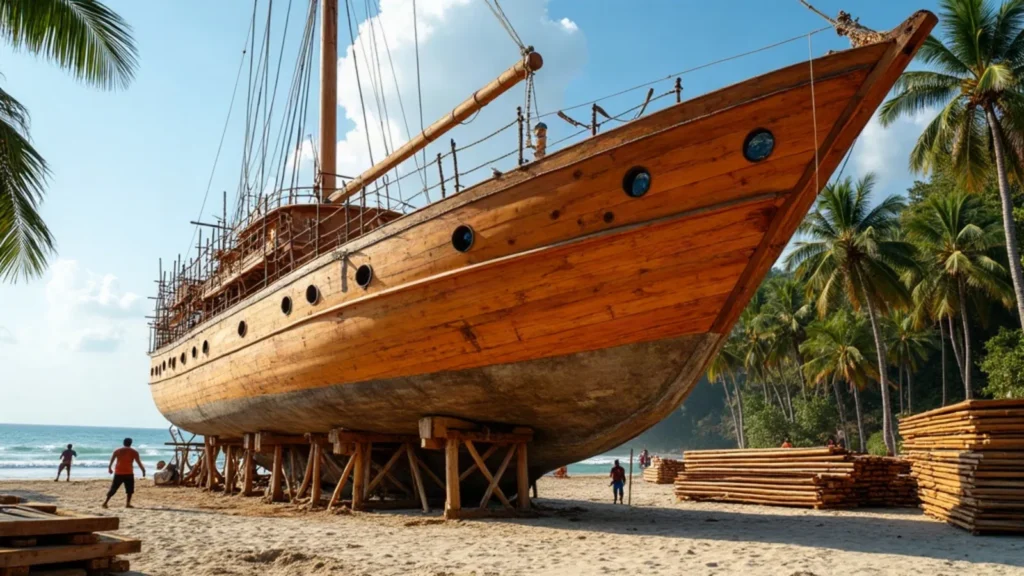
Commissioning a dive liveaboard for Raja Ampat runs through seven stages: operating profile, concept and general arrangement, technical specification, contract, construction with milestone inspections, commissioning, and sea trials with handover. Design and specification take three to six months; construction of a 30 m vessel takes roughly 18 to 24 months. The single biggest determinant of whether a project runs well is how much work is done before anyone cuts timber.
Stage 1 — Operating profile (2–4 weeks)
Everything starts here, and owners who rush it pay for it twice. You need five things written down: the itineraries you will actually sell, the guest and crew numbers, the season length and sea days per month, the crew you can realistically recruit and keep, and a budget ceiling in USD.
The itinerary is the most consequential. A vessel running seven-night Dampier Strait loops resupplying at Sorong is a different design from one running twelve-night Misool and Wayag expeditions with no refuelling stop. The second needs substantially more fuel and water volume, and that volume has to be designed into the hull, not added later.
Deliverable: a one-page brief. If you cannot fit it on one page, the business plan is not settled yet.
Stage 2 — Concept and general arrangement (6–12 weeks)
The concept converts the brief into a vessel: length, beam, displacement, hull material and a general arrangement showing every deck. This is where cabin count, dive deck layout, crew accommodation and machinery spaces get fixed relative to each other.
Expect several iterations. The common conflicts are predictable — guests want more cabins, the dive operation wants more deck, the engineer wants more machinery space, and the naval architect wants the weight kept low. Resolving those on paper costs meetings. Resolving them after the frames are standing costs months.
Two decisions must not be deferred past this stage: hull material, because it changes structure and build method entirely (see hull material options), and the certification route, because class or BKI involvement changes scantlings and escape arrangements (see working with class and BKI).
Stage 3 — Technical specification (4–8 weeks)
The specification is a numbered document listing every system, capacity, equipment item, finish standard and tolerance, plus an explicit list of what the owner supplies. It is the annex to the contract and the reference for every inspection.
A weak specification is the most expensive document in shipbuilding. Every ambiguity becomes a variation order, and variation orders are priced without competitive pressure because the yard is already building your boat. Insist on numbers: not “adequate air conditioning” but a stated cooling capacity per space derived from a heat-load calculation; not “quality joinery” but named materials and finish schedules. The framework we use is on the technical specifications page.
Stage 4 — Contract and milestone structure
A sound contract has the specification as a numbered annex, staged payments tied to inspected physical progress, a written variation procedure with agreed pricing method, a defined delivery condition, and a documented handover package. Typical liveaboard milestones: design release 10%, keel and structure 15%, hull framed 20%, hull closed and main machinery installed 20%, systems commissioned and outfitting complete 20%, sea trials and handover 15%.
Read questions to ask before signing before committing. Payment mechanics are covered on the pricing and investment page.
Stage 5 — Construction (12–20 months)
The build itself moves through structure, hull closure, machinery installation, systems, then outfitting. Two owner behaviours consistently protect a project:
- Attend the milestone inspections. Not to supervise craftsmanship, but to verify that what is being built matches the specification while changes still cost hours rather than weeks.
- Freeze the design. Owner-initiated changes during construction are the most common cause of both delay and budget overrun. If a change is genuinely necessary, price and schedule it formally before it is executed.
Long-lead machinery is ordered at specification stage, not when the hull is ready — see Sorong logistics for why this matters more in West Papua than elsewhere.
Stage 6 — Commissioning (6–10 weeks)
Commissioning is where systems are proven individually and together: engines run under load, generators tested against real hotel demand, air conditioning balanced, watermaker output measured, compressors and nitrox verified, tankage calibrated, and navigation and communications proven. Dive-specific systems get their own protocol — see oxygen systems and safety.
Insist that commissioning happens against a written checklist with recorded results, not a verbal confirmation that everything works.
Stage 7 — Sea trials and handover (2–4 weeks)
Trials should take place in conditions resembling the vessel’s working environment. A boat tested in flat water has not been tested against the Dampier Strait. Verify speed and fuel burn at several settings to confirm the economical cruise band, check manoeuvring at low speed in current, run the generators at full hotel load in tropical heat overnight, and launch and recover the tender in a seaway.
The handover package should include as-built drawings, equipment manuals and warranty documents, a tank calibration table, the commissioning records, a spare parts inventory and a maintenance schedule. Then plan the delivery voyage and the first-season spares — both are covered in the timeline article.
What to start with
Write the one-page brief. Then send it with a USD budget ceiling to +62 811 3941 4563 or bd@juaraholding.com. Vessel-specific detail is on the liveaboard new-build page.
Frequently Asked Questions
What is the step-by-step process to commission a new-build dive boat in Sorong or West Papua?
Seven stages: write the operating profile, develop concept and general arrangement drawings, produce a numbered technical specification, sign a contract with milestone payments, build with inspections at each milestone, commission the systems against a written checklist, then complete sea trials and a documented handover.
How long does the design phase take before construction starts?
Typically three to six months for a liveaboard: two to four weeks on the operating profile, six to twelve weeks on concept and general arrangement, and four to eight weeks producing the technical specification.
What causes most new-build delays and overruns?
Owner-initiated changes during construction, and ambiguous specifications that turn into variation orders priced without competitive pressure. Both are avoided by investing more time before the contract is signed.